
Invasion of Al-Kudr (Ghazwat Qarqarat al-Kudr)
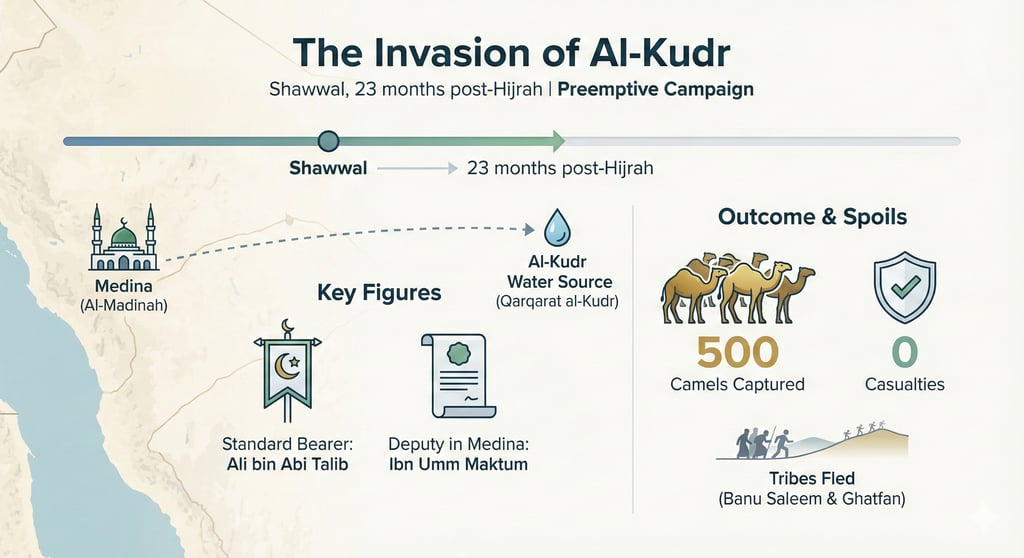
The Invasion of Al-Kudr (Ghazwat Qarqarat al-Kudr) occurred in Shawwal, twenty-three months after the Hijrah (approx. 2 AH). It was a preemptive campaign led by the Prophet Muhammad (peace be upon him) against the tribes of Banu Saleem and Ghatfan, who were assembling at the water source of Al-Kudr to attack Medina. Upon the arrival of the Muslim army, the enemy forces fled to the tops of the valleys, resulting in a bloodless victory. The Muslims captured 500 camels as spoils, which were distributed among the soldiers, and a young slave named Yasar, whom the Prophet later emancipated. Ali bin Abi Talib served as the standard-bearer, while Ibn Umm Maktum was appointed deputy in Medina during the expedition.
THE MILITARY HISTORY OF THE SEERAHSEERAHPOLITICSMILITARYHISTORY
Abdur Sami
12/30/20252 min read
The Invasion of Al-Kudr (Ghazwat Qarqarat al-Kudr) against Banu Saleem stands as a significant preemptive military campaign in early Islamic history, demonstrating the Prophet Muhammad's (peace be upon him) strategic vigilance in securing the Islamic state's borders against gathering tribal threats.
1. Historical Context and Timing
The Invasion of Al-Kudr took place in the month of Shawwal, specifically in the twenty-third month after the Prophetic Hijrah (Migration) to Medina. This occurred shortly after the Battle of Badr, as the Muslims were consolidating their position in the region.
Date: The Prophet (peace be upon him) set out for this campaign in the middle of Shawwal.
Duration: The entire expedition lasted for fifteen nights, after which the Prophet returned to Medina.
2. Causes and Intelligence
The primary catalyst for this campaign was intelligence received by the Prophet (peace be upon him) regarding a hostile gathering. News reached Medina that the tribe of Banu Saleem (Banu Sulaym) and Banu Ghatfan were assembling forces at a water source known as Al-Kudr (Qarqarat al-Kudr) with the intent to threaten or attack the Muslims.
Acting solely on this strategic intelligence, the Prophet (peace be upon him) decided to launch a preemptive strike to disperse the gathering before it could materialize into a direct assault on Medina.
3. Leadership and Mobilization
Upon deciding to march, the Prophet (peace be upon him) made the following administrative and military appointments:
Standard Bearer: The banner (Liwa) of the Muslim army was carried by Ali bin Abi Talib (may Allah be pleased with him).
Deputy in Medina: To govern Medina in his absence, the Prophet appointed Ibn Umm Maktum (may Allah be pleased with him). However, other narrations in the same manuscript note a difference of opinion, suggesting it might have been Siba' bin Urfuta al-Ghifari.
4. Events of the Expedition
The Prophet (peace be upon him) marched with his companions towards the location of the threat.
Arrival at Al-Kudr: When the Muslim forces reached the water source of Al-Kudr, they found the area deserted. The tribes of Banu Saleem and Ghatfan had fled to the tops of the valleys upon hearing of the Muslim army's approach.
The Capture: Although no battle took place, the Muslims secured the area. They sent a detachment into the valley, which found the camels of the enemy grazing without their owners. They also captured a young slave named Yasar, who belonged to the tribe.
5. Spoils of War and Distribution
Despite the lack of active combat, the expedition yielded significant spoils in the form of livestock left behind by the fleeing tribes.
Livestock: The Muslims captured 500 camels.
Division: The Prophet (peace be upon him) divided the spoils among the participants. After setting aside the Khums (one-fifth share for the state), each soldier received two camels as their share.
The Fate of Yasar: The captured boy, Yasar, was included in the Prophet's (peace be upon him) share of the spoils. The Prophet later emancipated him. The reason for his emancipation was that the Prophet saw him praying and stated, "He has entered into surrender (Islam)," and thus set him free.
6. Strategic Outcome
The expedition was a strategic success. It dispersed the gathering of Banu Saleem and Ghatfan without the loss of Muslim life, secured significant resources (camels) for the community, and reinforced the prestige of the rising Islamic state in the eyes of neighboring Bedouin tribes. The Prophet (peace be upon him) returned to Medina triumphant, having neutralized a potential threat on the borders.
References:
Al-Waqidi, M. (n.d.). Maghazi al-Waqidi (Vol. 1)
Ibn Sayyid al-Nas, M. (n.d.). Uyun al-Athar (Vol. 1)