
The Battle of Badr: A Historical Analysis of the First Decisive Encounter in Islam
The Battle of Badr occupies a central position in Islamic history as the first major military confrontation between the Muslims of Medina and the Quraish of Mecca. Based on an analysis of the classical manuscripts available in the Knowledgebase, this article reconstructs the events, context, and outcomes of this decisive engagement.
THE MILITARY HISTORY OF THE SEERAHSEERAHPOLITICSMILITARYHISTORY
Abdur Sami
12/29/20254 min read
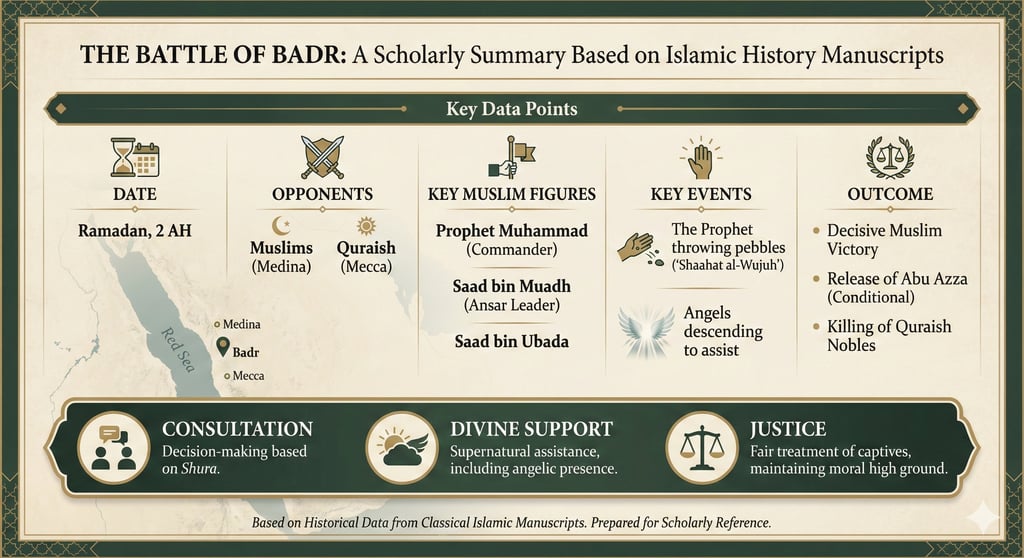
Introduction The Battle of Badr constitutes a pivotal moment in Islamic history, marking the first major military confrontation between the early Muslims and the Quraysh of Mecca. Occurring in the second year of the Hijrah, this engagement transformed the Muslim community from a marginalized group into a significant political and military entity in the Arabian Peninsula. Historical sources indicate that the Prophet Muhammad (peace be upon him) led this expedition personally, which took place on Friday, the 17th of Ramadan, a date that coincided with the revelation of the Quran and the victory at Badr. This article examines the mobilization, strategic maneuvers, combat dynamics, and the aftermath of the battle as recorded in primary historical texts.
Prelude and Mobilization The immediate catalyst for the Battle of Badr was the interception of a large Qurayshi caravan returning from the Levant, led by Abu Sufyan. The Prophet Muhammad commanded the Muslims to intercept this caravan, which carried significant wealth and merchandise belonging to the Quraysh,. The Muslim army departed Medina in the middle of Ramadan, with the Prophet appointing Abu Lubabah as the interim governor of Medina.
The Muslim forces were organized with specific standards; the white banner was entrusted to Mus'ab bin Umayr, while the black banners were carried by Ali bin Abi Talib and Sa'd bin Mu'adh. The intent was initially to capture the caravan, but the situation escalated into a full-scale military confrontation when Abu Sufyan, alerting Mecca of the danger, managed to divert the caravan along the coastal route, while the Quraysh mobilized a formidable army to protect their interests and prestige,.
Strategic Maneuvers and Consultation Upon reaching the vicinity of Badr, the Prophet engaged in strategic consultation with his companions, a practice that underscored the communal nature of decision-making in early Islam. A critical intervention was made by Al-Hubab bin Al-Mundhir, who inquired whether the Prophet’s choice of campsite was based on divine revelation or military strategy. When the Prophet confirmed it was a matter of strategy, Al-Hubab suggested moving to the water source nearest to the enemy, building a basin to store water for the Muslims, and destroying the other wells. This tactic was designed to secure water for the Muslim army while depriving the opposing forces, thereby forcing the Quraysh to fight under thirsty conditions.
The Combat The battle commenced with traditional single combat. Prominent Qurayshi warriors, including Utbah bin Rabi'ah, his brother Shaybah, and his son Al-Walid, stepped forward to challenge the Muslims,. They were met by Hamza bin Abdul-Muttalib, Ali bin Abi Talib, and Ubaydah bin Al-Harith. Hamza killed Shaybah, and Ali killed Al-Walid, while Ubaydah exchanged blows with Utbah, resulting in Ubaydah’s injury before his companions finished off Utbah and carried Ubaydah back to the Muslim lines,.
Following these duels, the general engagement began. The Prophet Muhammad spent much of the battle in a shelter (Areesh) constructed for him, fervently supplicating to God for victory, accompanied by Abu Bakr, who reassured him of God's promise. Historical narratives emphasize the role of divine intervention; it is recorded that angels descended to assist the Muslims, with Gabriel described as leading his horse into the fray. The presence of the angels and the Prophet’s incitement of the believers instilled tranquility and steadfastness in the Muslim ranks while striking terror into the enemy.
Casualties and Significant Deaths The battle resulted in a decisive victory for the Muslims and a catastrophic loss for the Quraysh. Several senior leaders of Mecca were killed, including Abu Jahl (Amr bin Hisham), who was considered the "Pharaoh of this nation",. Other notables killed included Umayyah bin Khalaf and Zam'ah bin Al-Aswad. The Prophet ordered that the bodies of the polytheist leaders be thrown into a dry well (Al-Qalib) at Badr. Standing over the pit, the Prophet addressed the dead, asking if they had found the punishment promised by their Lord to be true, confirming that he had found the victory promised by his Lord to be true,.
Humanitarian and Disciplinary Incidents Despite the intensity of the conflict, sources record moments illustrating the internal discipline of the Muslim army. During the alignment of the troops, the Prophet used an arrow to straighten the rows and nudged Sawad bin Ghaziyyah, who was protruding from the line. Sawad complained of pain and requested retribution; in a display of humility, the Prophet uncovered his stomach, inviting Sawad to retaliate. Instead, Sawad kissed the Prophet’s stomach, embracing him in what he believed might be his final moments.
Aftermath and Captives Following the victory, the Prophet dispatched Zayd bin Harithah and Abdullah bin Rawahah to Medina to announce the triumph. The battle yielded numerous captives, including the Prophet's uncle, Al-Abbas bin Abdul-Muttalib. The issue of captives was a matter of deliberation; ultimately, ransom was accepted. The Prophet ensured that Al-Abbas paid a heavy ransom for himself and his nephews, refusing to waive any part of it despite their kinship.
Conclusion The Battle of Badr established the Muslims as a formidable force in Arabia. It was not merely a raid for booty but a foundational event that shifted the balance of power. The elimination of Quraysh's senior leadership, such as Abu Jahl and Utbah bin Rabi'ah, created a power vacuum in Mecca and solidified the religious and political authority of the Prophet Muhammad in Medina. The event is immortalized in Islamic history as the "Day of the Criterion" (Yawm al-Furqan), distinguishing truth from falsehood.
References
Al-Maqdisi, M. (1999). Al-Bad' wa al-Tarikh (Vol. 2, 5). Maktabat al-Thaqafa al-Diniya.,,. Ibn Kathir, I. (1988). Al-Bidaya wa al-Nihaya (Vol. 3, 4, 5). Dar Hajar.,,,,,,,,,,,,,,. Abu Nu'aym, A. (n.d.). Al-Mustakhraj min Kutub al-Nas.,,.