
The Battle of Uhud: A Historical Reconstruction from Classical Manuscripts
The Battle of Uhud (Ghazwat Uḥud) represents a pivotal event in early Islamic history, occurring in the third year after the Hijrah (3 AH). Following the decisive Muslim victory at Badr in 2 AH, the Quraysh of Mecca sought to restore their prestige and avenge their fallen leaders. This research article provides a detailed reconstruction of the battle based exclusively on classical Islamic historiography, specifically the Maghāzī and Sīrah literature of Ibn Isḥāq (d. 151 AH), Al-Wāqidī (d. 207 AH), and Ibn Sa‘d (d. 230 AH), as well as authentic hadith collections.
THE MILITARY HISTORY OF THE SEERAHSEERAHMILITARYPOLITICSHISTORY
Abdur Sami
1/6/20264 min read
Context and Mobilization
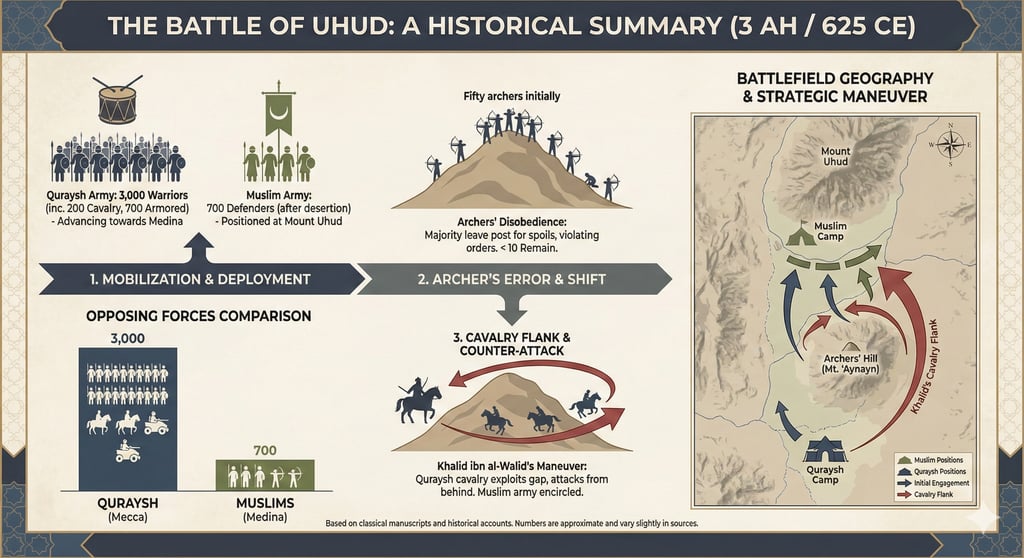
The Quraysh Mobilization Following their defeat at Badr, the Quraysh assembled a formidable force to attack Medina. According to Ibn Isḥāq, the Meccan army consisted of 3,000 warriors. This force included 200 cavalry led by Khālid ibn al-Walīd (right flank) and ‘Ikrimah ibn Abī Jahl (left flank), and 700 armored soldiers (Ibn Hisham, 1955). The army was commanded by Abū Sufyān ibn Ḥarb, accompanied by women of the Quraysh, including his wife Hind bint ‘Utbah, who beat drums to incite the warriors to vengeance (Al-Waqidi, 2011).
The Muslim Consultation (Shūrā) Upon receiving intelligence of the Meccan advance, Prophet Muhammad (peace be upon him) convened a council of war. The Prophet initially favored a defensive strategy, suggesting the Muslims remain within the fortified precincts of Medina. However, a group of zealous companions, particularly those who had missed Badr, argued for meeting the enemy in the open field (Ibn Hisham, 1955). The Prophet acceded to the majority view, donned his armor, and marched out with approximately 1,000 men.
The Desertion Before reaching the battlefield, ‘Abd Allāh ibn Ubayy ibn Salūl, the leader of the Munāfiqūn (hypocrites), withdrew with approximately 300 men, arguing that the Prophet had ignored his advice to stay in the city. This reduction left the Muslim army with only 700 personnel (Al-Waqidi, 2011).
Strategic Deployment
The Muslim army arrived at the valley of Uhud on Saturday, 7 Shawwāl, 3 AH (March 625 CE). The Prophet positioned his forces with Mount Uhud to their rear, securing the army's back against the mountain slopes.
The Archers at Mount ‘Aynayn Recognizing the threat posed by the Meccan cavalry, the Prophet stationed a corps of 50 archers on a small hill (later known as Jabal al-Rumāh) to the south of the Muslim camp. He placed them under the command of ‘Abd Allāh ibn Jubayr with explicit, emphatic orders recorded in Sahih al-Bukhari: "If you see us snatching the spoils, do not come down to share with us; and if you see that they [the enemy] have defeated us ... do not come to our help" (Al-Bukhari, n.d., Hadith 3039).
The Engagement
The Duel and Initial Advance The battle commenced with single combat. Talḥah ibn Abī Talḥah, the standard-bearer of the Quraysh, issued a challenge which was met by ‘Alī ibn Abī Ṭālib. ‘Alī struck Talḥah down, prompting the Prophet and the Muslims to shout "Allāhu Akbar" (Ibn Hisham, 1955).
Following this, the Muslims launched a spirited general offensive. The distinct bravery of figures like Ḥamzah ibn ‘Abd al-Muṭṭalib and Muṣ‘ab ibn ‘Umayr (the standard-bearer) caused the Meccan lines to break. The Quraysh began to retreat in disorder, abandoning their camp.
The Turning Point
The Error of the Archers Witnessing the Meccan retreat, the majority of the archers on Mount ‘Aynayn assumed the battle was won. Despite the protests of their commander ‘Abd Allāh ibn Jubayr, roughly 40 archers descended the hill to collect spoils. Only ‘Abd Allāh ibn Jubayr and fewer than ten men remained at their post (Al-Bukhari, n.d.).
The Counter-Attack Khālid ibn al-Walīd, observing the abandonment of the strategic hill, led his cavalry in a sweeping maneuver around the rear of the Muslim army. They overwhelmed the few remaining archers and attacked the unsuspecting Muslim main body from behind. The fleeing Meccan infantry, seeing their cavalry's success, rallied and returned to the fight (Al-Waqidi, 2011).
The Crisis and Casualties
Martyrdom of Ḥamzah In the ensuing chaos, Ḥamzah ibn ‘Abd al-Muṭṭalib was stalked by Waḥshī ibn Ḥarb, an Abyssinian slave promised his freedom by Jubayr ibn Muṭ‘im if he killed Ḥamzah. Waḥshī struck Ḥamzah with a javelin, killing him. Subsequently, Hind bint ‘Utbah mutilated Ḥamzah’s body in an act of vengeance for her father, who was killed at Badr (Ibn Hisham, 1955).
Injuries to the Prophet The Muslims were encircled, and the Prophet became a primary target. Narrations in Sahih Muslim and Sirat Ibn Hisham detail his injuries:
A stone struck his face, breaking his lower right lateral incisor.
His helmet was crushed, driving metal rings into his cheek.
His lip was wounded.
The Prophet was defended by a small circle of companions, including Talḥah ibn ‘Ubayd Allāh, who shielded the Prophet with his own body until his hand was paralyzed, and Sa‘d ibn Abī Waqqāṣ, who fired arrows in defense (Al-Bukhari, n.d.).
Rumors of Death Muṣ‘ab ibn ‘Umayr, who bore a physical resemblance to the Prophet, was slain by Ibn Qami'ah. Ibn Qami'ah shouted that he had killed Muhammad, causing panic among the Muslims. Many fled, while others threw down their weapons in despair until Ka'b ibn Malik spotted the Prophet alive and rallied the believers (Ibn Hisham, 1955).
Conclusion and Aftermath
The battle ended with the Muslims retreating to the slopes of Mount Uhud, where the Quraysh could not easily pursue them. Abu Sufyān, satisfied with the vengeance for Badr, ordered the Meccan army to withdraw.
The toll was heavy: 70 Muslims were martyred, compared to roughly 22 casualties among the Quraysh (Ibn Sa'd, 1993). The Prophet ordered the martyrs to be buried on the battlefield in their blood-stained clothes, with two or three men sometimes buried in a single grave due to the sheer number of casualties.
References
Al-Bukhari, M. (n.d.). Sahih al-Bukhari. (M. M. Khan, Trans.). Darussalam.
Al-Waqidi, M. (2011). The Life of Muhammad: Al-Waqidi's Kitab al-Maghazi. (R. Faizer, Trans.). Routledge. (Original work published approx. 822 CE).
Ibn Hisham, A. (1955). The Life of Muhammad: A Translation of Ishaq’s Sirat Rasul Allah. (A. Guillaume, Trans.). Oxford University Press. (Original work published approx. 833 CE).
Ibn Sa'd, M. (1993). Kitab al-Tabaqat al-Kabir. (S. M. Haq, Trans.). Kitab Bhavan. (Original work published approx. 845 CE).