
The Elimination of Ka'b ibn al-Ashraf: A Historical Analysis of Intelligence and Military Operations in Early Medina
This article provides a scholarly reconstruction of the assassination of Ka'b ibn al-Ashraf, a chieftain of the Banū al-Naḍīr, based exclusively on classical Islamic historiography such as the works of Al-Wāqidī and Ibn Hishām. The study details the strategic motivations behind the operation—specifically Ka'b's treasonous incitement of war following the Battle of Badr and his defamation of the Muslim community. It further analyzes the tactical execution led by Muḥammad ibn Maslamah, highlighting the use of psychological warfare and deception, and concludes with an examination of the political ramifications that solidified the internal security and authority of the early Islamic state in Medina.
THE MILITARY HISTORY OF THE SEERAHSEERAHPOLITICSMILITARYHISTORY
Abdur Sami
12/31/20254 min read
Abstract
This article examines the historical account of the assassination of Ka'b ibn al-Ashraf, a prominent chieftain of the Banū al-Naḍīr and a wealthy poet in Medina. Drawing exclusively from classical Islamic historiography, this study outlines the motivations behind the operation, the tactical planning executed by the Companions of the Prophet (ﷺ), and the political aftermath of the event within the Medinan society.
1. Introduction and Historical Context
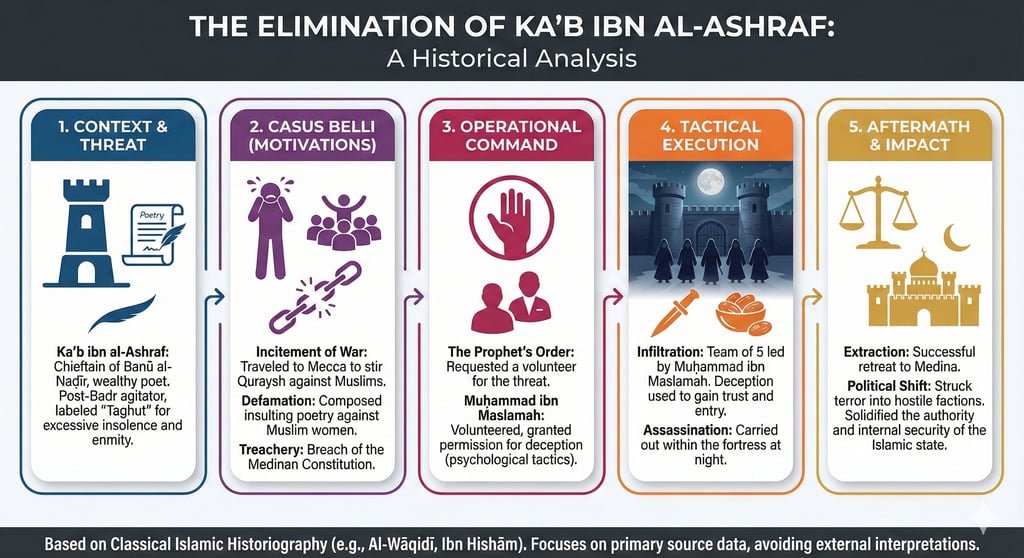
Ka'b ibn al-Ashraf was a man of mixed lineage; his father was from the Tayy tribe and his mother was from the Jewish tribe of Banū al-Naḍīr. He was a wealthy figure known for his fortress (Hiṣn) and his eloquence in poetry. Following the Battle of Badr, where the Muslims achieved a decisive victory over the Quraysh, Ka'b ibn al-Ashraf emerged as a primary agitator against the Islamic state.
Classical sources identify him as a "Taghut" (tyrant) due to his excessive insolence and deep-seated enmity toward the Messenger of Allah (ﷺ). He utilized his wealth and poetic influence to incite hostilities against the Muslims (Al-Ṣāliḥī, Subul al-Hudā wa al-Rashād, Vol. 11, p. 305).
2. Casus Belli: Motivations for the Operation
The decision to eliminate Ka'b ibn al-Ashraf was not arbitrary but stemmed from specific acts of treason and belligerence that threatened the stability of Medina:
Incitement of War: Upon hearing the news of the Muslim victory at Badr, Ka'b traveled to Mecca to incite the Quraysh to wage war against the Prophet (ﷺ), weeping over the pagan dead to stir their emotions.
Defamation and Harassment: He composed amatory and insulting poetry directed at the Muslim women, causing significant distress to the Muslim community.
Political Treachery: His actions were viewed as a breach of the constitution (covenant) that existed between the Prophet (ﷺ) and the various factions in Medina.
Al-Ṣāliḥī records that the Quranic verse referencing those who "believe in Jibt and Taghut" (referring to sorcery and tyranny) was associated with figures like Ka'b, who was explicitly labeled a Taghut for his leadership in opposing the Prophet (Al-Ṣāliḥī, Subul al-Hudā wa al-Rashād, Vol. 11, p. 305).
3. The Operational Command
The operation was initiated by the Prophet (ﷺ) who publicly requested a volunteer to deal with the threat. He asked: "Who is for Ka'b ibn al-Ashraf? For he has hurt Allah and His Messenger."
Muḥammad ibn Maslamah, a leader from the Aws tribe, volunteered for the mission. He asked the Prophet (ﷺ): "O Messenger of Allah, do you wish for me to kill him?" The Prophet replied in the affirmative. Understanding the difficulty of infiltrating Ka'b's fortified position, Muḥammad ibn Maslamah requested permission to say things (deception) to gain Ka'b's trust. The Prophet (ﷺ) granted him permission to use deception, establishing a legal precedent in military tactics regarding enemies of the state (Al-Bukhārī, cited in Zād al-Ma‘ād, Vol. 3).
4. Tactical Execution
The operation was carried out by a team of five men from the Aws tribe to ensure tribal solidarity and utilize specific connections:
Muḥammad ibn Maslamah (Team Leader)
Silkan ibn Salamah (Known as Abū Nā'ilah, the foster brother of Ka'b)
Abbād ibn Bishr
Al-Ḥārith ibn Aws
Abū 'Abs ibn Jabr
4.1 Infiltration and Deception
Abū Nā'ilah utilized his foster relationship to approach Ka'b. He went to Ka'b’s fortress and complained about the "hardship" and "poverty" brought upon them by the Prophet (ﷺ), pretending to align with Ka'b's sentiments. This psychological tactic successfully lowered Ka'b's guard. Abū Nā'ilah requested to borrow food (dates) and offered weapons as collateral (pawn), a strategic move to justify bringing armed men into the fortress later without raising suspicion. Ka'b agreed to the arrangement.
4.2 The Assassination
On a moonlit night, the team arrived at Ka'b’s fortress. Ka'b, trusting them, came down to meet them despite his wife's warnings that she "heard a voice that sounds like blood is dripping from it."
The group walked with Ka'b for a while. Abū Nā'ilah, pretending to admire the perfume Ka'b was wearing, asked to smell his head. He did this once to establish comfort. On the second attempt, when he had a firm grip on Ka'b's hair, he signaled his companions: "Smite the enemy of Allah!"
The team struck him with their swords. However, in the chaos and darkness, the swords clashed against each other, and Ka'b was not immediately killed. Muḥammad ibn Maslamah then used a dagger (or short sword) placed against Ka'b's lower body and thrust it, finally killing him. Ka'b let out a scream that terrified the nearby forts, and fires were lit on the watchtowers (Al-Wāqidī, Mughāzī, Vol. 1; Ibn Hishām, Sīrah).
5. Extraction and Aftermath
During the scuffle, Al-Ḥārith ibn Aws was accidentally wounded by one of his companions' swords. The team supported him and retreated quickly towards Medina. They reached Baqī‘ al-Gharqad and proclaimed "Allāhu Akbar," signaling the success of the mission to the Prophet (ﷺ).
The Prophet (ﷺ) treated Al-Ḥārith’s wound with his saliva, and it healed. The news of Ka'b's death struck terror into the hearts of the Jewish tribes in Medina, specifically Banū al-Naḍīr, realizing that the Prophet (ﷺ) would no longer tolerate treason or active instigation of war. This event marked a shift in the balance of power, solidifying the authority of the Islamic state within Medina (Al-Wāqidī, Mughāzī, Vol. 1).
6. Conclusion
The assassination of Ka'b ibn al-Ashraf was a pivotal "special operation" in Islamic history. It neutralized a significant existential threat who was actively mobilizing enemy forces against Medina. The operation demonstrated the use of intelligence, psychological warfare, and the principle that security agreements (covenants) are nullified by treason.
References:
Al-Ṣāliḥī, M. (n.d.). Subul al-Hudā wa al-Rashād fī Sīrat Khayr al-‘Ibād (Vol. 11).
Al-Wāqidī, M. (1989). Kitāb al-Mughāzī (Vol. 1). Beirut: Dar al-A'lami.
Ibn Hishām, A. (1955). Al-Sīrah al-Nabawiyyah (Vol. 2). Cairo: Mustafa al-Babi al-Halabi.
Ibn Qayyim al-Jawziyya. (n.d.). Zād al-Ma‘ād fī Hady Khayr al-‘Ibād (Vol. 3).