
The Enduring Legacy: How Pre-Islamic Tribal Dynamics Shaped the Early Muslim Conquests
The early Muslim conquests, which unfolded with astonishing speed and scale in the seventh century, are often portrayed as a singular event born ex nihilo from the crucible of a new faith. This perspective, however, obscures the deep historical currents that made such an expansion possible. It treats the Arabian peninsula as a historical vacuum, ignoring the sophisticated and volatile social, military, and political landscape that preceded Islam. This analysis challenges the traditional ex nihilo narrative of the conquests, arguing instead that the early Islamic state's primary strategic achievement was the ideological and organizational alchemy that transformed the latent potential of Arabian tribalism—itself a product of centuries of adaptation to a harsh environment—into a coherent and world-altering expansionary force. To understand this transformation, we will first examine the bedrock of Arabian society: the core values and structures of the tribe. We will then explore the dynamic pre-Islamic political landscape, a world of powerful confederations and external rivalries that provided a blueprint for large-scale mobilization. Following this, we will analyze the critical nexus between military readiness and economic life, where desert caravans functioned as proto-armies. Finally, this analysis will culminate in an assessment of how the early Islamic state masterfully repurposed this tribal engine, channeling its immense energy outward to reshape the world.
POLITICSMILITARYHISTORY
Abdur Sami
12/19/20256 min read
1.0 Introduction: Beyond the Vacuum
The early Muslim conquests, which unfolded with astonishing speed and scale in the seventh century, are often portrayed as a singular event born ex nihilo from the crucible of a new faith. This perspective, however, obscures the deep historical currents that made such an expansion possible. It treats the Arabian peninsula as a historical vacuum, ignoring the sophisticated and volatile social, military, and political landscape that preceded Islam. This analysis challenges the traditional ex nihilo narrative of the conquests, arguing instead that the early Islamic state's primary strategic achievement was the ideological and organizational alchemy that transformed the latent potential of Arabian tribalism—itself a product of centuries of adaptation to a harsh environment—into a coherent and world-altering expansionary force.
To understand this transformation, we will first examine the bedrock of Arabian society: the core values and structures of the tribe. We will then explore the dynamic pre-Islamic political landscape, a world of powerful confederations and external rivalries that provided a blueprint for large-scale mobilization. Following this, we will analyze the critical nexus between military readiness and economic life, where desert caravans functioned as proto-armies. Finally, this analysis will culminate in an assessment of how the early Islamic state masterfully repurposed this tribal engine, channeling its immense energy outward to reshape the world.
2.0 The Bedrock of Arab Society: Core Tribal Structures and Values
In the harsh, resource-scarce environment of pre-Islamic Arabia, the tribe was not merely a social preference but the fundamental organizing principle of life itself. It was the sole provider of security, identity, and economic opportunity. To comprehend the vast reserves of manpower, the deep-seated motivations, and the fierce loyalties that defined the era, one must first understand the internal mechanics of this social bedrock.
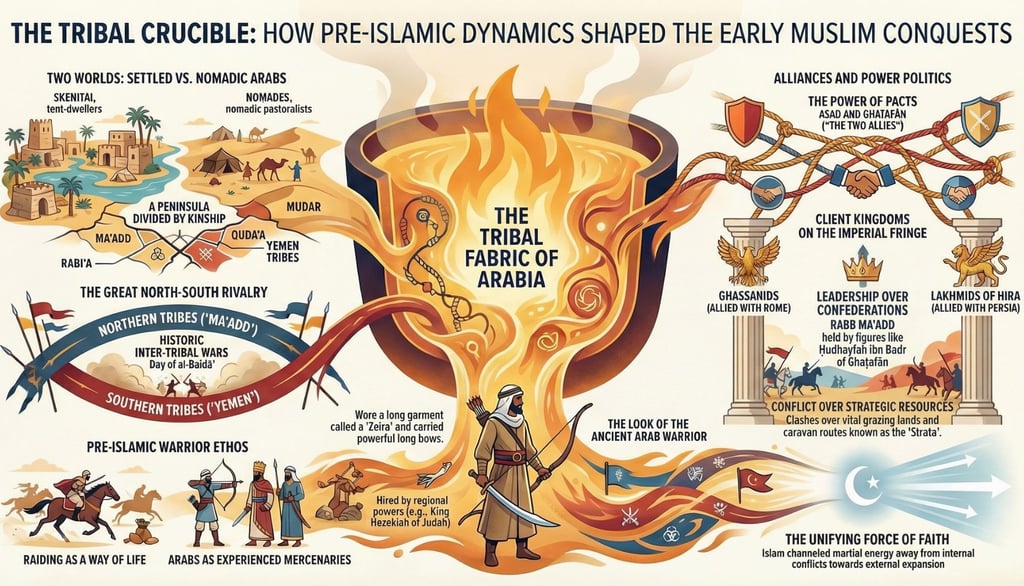
The primary engine for social cohesion and military action was the concept of Asabiyyah, or group solidarity. This potent bond, born of kinship and shared struggle, was the ultimate source of protection and power, obligating members to defend one another unconditionally. The tribe’s collective strength was the only true guarantee of an individual's survival and standing. Loyalty was not an abstract virtue; it was the essential currency of existence.
The absolute necessity of this loyalty was reinforced by the severe consequences of tribal exclusion. An individual who violated the tribe's norms or failed in their duties could be cast out, facing a fate often worse than death. The historical sources identify two such statuses: the الخليع (al-Khali' - the cast-out) and the الطريد (al-Tarid - the banished). To be declared a Khali' or Tarid was to be stripped of one's social existence—to become a non-person in a world where the collective was the only shield against annihilation. This powerful social mechanism ensured that the tribe remained a cohesive and formidable unit, ready for collective action. These internal dynamics prepared the ground for how tribes would interact with one another on the larger political stage.
3.0 The Political Chessboard: A World of Alliances and Rivalries
Contrary to the image of a static and isolated backwater, pre-Islamic Arabia was a dynamic and volatile political arena. It was characterized by shifting alliances, large-scale confederations, and constant power struggles, often influenced by the great empires on its periphery. The patterns of conflict and cooperation established in this period created a precedent for the kind of large-scale military mobilization that would later characterize the Islamic conquests.
The political landscape was dominated by two major spheres of influence, which frequently clashed for dominance. The historical sources highlight the formation of significant power blocs built from multiple tribes:
Confederation/Power Bloc
Constituent Tribes/Key Figures
Ma'add (معد) Confederation
Mudar (مضر), Rabi'a (ربيعة), Quda'a (قضاعة). Often united to counter Yemeni influence.
Yemeni (يمن) Sphere of Influence
A shifting alignment of southern tribes, often defined by its opposition to the northern Ma'add bloc rather than as a single, unified confederation.
These large-scale confederations, though often temporary, served as crucial precedents. They habituated the tribes to multi-clan command structures and demonstrated that mobilization on a supra-tribal scale was not only possible but essential for survival and dominance in the peninsula's harsh political ecosystem.
This internal rivalry was often manipulated by external powers seeking to project their influence into Arabia. A clear example cited in historical accounts is the intervention by the rulers of Yemen—possibly linked to the Abyssinian ruler Abraha (أبرهة)—who appointed Zuhayr ibn Janab al-Kalbi (زهير بن جناب الكلبي) as a proxy ruler over the entire Ma'add confederation to ensure its subservience. This external imposition, however, triggered an indigenous response. Figures like Rabi'a ibn al-Harith (ربيعة بن الحارث) recognized the threat to their autonomy and worked to forge a united front of Mudar and Rabi'a tribes to resist Yemeni dominance. This history of strategic alliances and coalition warfare was sustained by the robust economic activities that connected the peninsula.
4.0 From Caravans to Armies: The Military-Economic Nexus
In pre-Islamic Arabia, economic survival and military preparedness were inextricably linked. The logistical challenges and defensive necessities of long-distance caravan trade created a natural foundation for organized martial activity. The caravans that traversed the deserts were more than simple merchant processions; they were highly organized, tribally-based enterprises that functioned as mobile economic and military units. These enterprises were, in essence, expressions of Asabiyyah mobilized for economic gain, where group solidarity was the primary insurance against the perils of the desert and the guarantor of profit.
As historical accounts describe, Meccan trade caravans required their own protection to guard valuable goods from raids. Participants were organized along tribal lines and accustomed to armed defense, effectively blurring the line between merchant and warrior. Furthermore, these commercial activities established Arab interests far beyond the traditional confines of the peninsula. A telling example is the fact that Abu Sufyan ibn Harb (أبو سufyan ibn Harb), a prominent Meccan leader, owned property in al-Balqa' (البلقاء), a region in modern-day Jordan. This detail is particularly significant, as it reveals that Arab commercial and territorial interests were already established in the very lands—the Levant—that would become the first major targets of the Islamic conquests.
This pre-existing system—a society organized for war, a political history of coalition-building, and an economy that doubled as military training—was a powerful engine of latent energy. The advent of Islam, therefore, must be analyzed not as the creator of this engine, but as the catalyst that engaged its gears and directed its immense force upon the world.
5.0 Harnessing the Tribal Engine: The Islamic Conquests
The strategic genius of the early Islamic state lay not in destroying the Arabian tribal system, but in fundamentally repurposing it. The ideology of Islam provided a new, transcendent form of Asabiyyah—a solidarity based on shared faith rather than shared bloodline—that was capable of uniting previously rivalrous tribes under a single banner. This new unity did not erase tribal identities, but it subordinated them to a higher purpose, redirecting the ingrained martial traditions and political energies of the Arab people.
This strategic rechanneling turned the potential for internal conflict into a powerful force for external expansion. The centuries of raiding, feuding, and coalition warfare were now directed outward against the Byzantine and Sasanian empires. This expansion was not a single event but a sustained campaign. The conquest of Al-Andalus in 92 AH during the Umayyad Caliphate (الدولة األموية) serves as a prime example. Launched from North Africa (المغرب األقصى), which had itself been conquered in the preceding decades, this campaign showcases the remarkable long-range striking power of an empire still fueled by its Arabian military core.
The advent of Islam triggered several key transformations that turned the tribal system into an engine of conquest:
Ideological Reframing: Asabiyyah, once tied to kinship and tribe, was sublimated into an Asabiyyah of faith, turning the energy of the inter-tribal raid (ghazw) outward into a unified campaign of conquest (fath).
Administrative Co-option: The caliphate did not abolish the existing leadership hierarchy but co-opted it, transforming tribal shaykhs into commanders (amirs) within a state military structure, thus preserving established chains of command and loyalty.
Strategic Reorientation: The scale and objective of military operations expanded dramatically, reorienting the logic of the caravan raid—focused on short-term economic gain—toward the long-term strategic goals of territorial conquest and state administration.
This masterful repurposing of a pre-existing social and military system is central to understanding the speed and success of the early conquests.
6.0 Conclusion: The Rechanneled River
The early Muslim conquests were not a spontaneous eruption from a barren desert. They were the culmination of social and political forces that had been developing in Arabia for centuries. The raw materials for this expansion were forged in the pre-Islamic era: a society founded on the powerful group solidarity of Asabiyyah; a political history defined by large-scale tribal confederations and sophisticated coalition warfare; and military traditions honed by the practical necessities of defending lucrative trade caravans. Islam did not create these forces, but it provided the ideological framework to unify and redirect them.
The unprecedented success of the early Muslim expansion is best understood not as the creation of a new flood, but as the masterful forging of a powerful, pre-existing river of tribal energy into a disciplined and unstoppable geopolitical current, aimed at a new, world-altering horizon.
References
Ali, J. (2001). Al-Mufassal fi Tarikh al-Arab Qabl al-Islam (4th ed.). Dar al-Saqi. Ibn al-Athir, A. (1987). Al-Kamil fi al-Tarikh (O. Tadmur, Ed.). Dar al-Kitab al-Arabi. Ibn Kathir, I. (1988). Al-Bidayah wa al-Nihayah (A. M. Al-Turki, Ed.). Dar Hajar. Ibn Kathir, I. (1932). Al-Bidayah wa al-Nihayah. Matba'at al-Sa'adah. Al-Ulaymi, A. (2010). Al-Tarikh al-Mu'tabar fi Anba' Man Ghabar (N. Talib, Ed.). Dar al-Nawadir.