
The Expedition of Abdullah ibn Unais (Sarīyyah Abdullah ibn Unais)
The Expedition of Abdullah ibn Unais (سرية عبد الله بن أنيس) was a significant covert military operation dispatched by the Prophet Muhammad (peace be upon him) in the early years of the Hijrah. This mission targeted a specific threat arising from the Banu Lihyan tribe, led by Sufyan ibn Khalid al-Hudhali.
THE MILITARY HISTORY OF THE SEERAHSEERAHPOLITICSMILITARYHISTORY
Abdur Sami
1/7/20263 min read
1. Historical Context and Dating
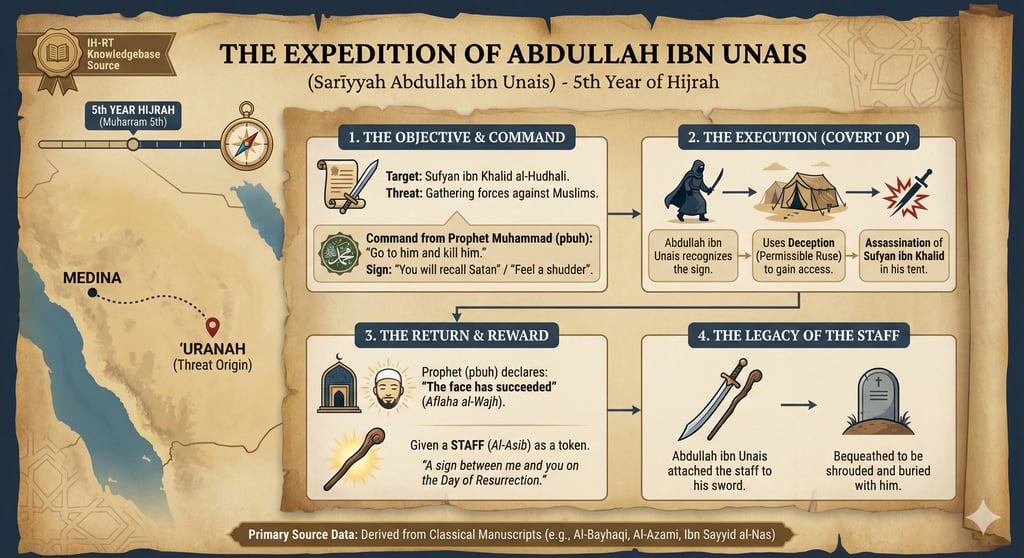
Scholars and biographers have recorded this expedition as taking place in the fifth year of the Hijrah.
Specific Date: It occurred on Monday, the 5th of Muharram, in the fifth year of the Hijrah (Al-Azami, 2011, Vol. 3). This places the event approximately twenty-six months after the Prophet’s migration to Medina.
Sequence: This expedition followed the events of Uhud and the tragedy of Al-Raji', serving as a preemptive strike against gathering threats from neighboring tribes (Ibn Sayyid al-Nas, 1992, Vol. 2).
2. The Objective
The primary objective of this mission was the elimination of Sufyan ibn Khalid al-Hudhali (also referred to in some texts as Khalid ibn Sufyan). Intelligence had reached the Prophet (peace be upon him) that Sufyan was gathering forces in a location called 'Uranah (or Batn 'Uranah) to launch an attack against the Muslims in Medina (Al-Azami, 2011, Vol. 3; Ibn Sayyid al-Nas, 1992, Vol. 2).
3. The Commissioning of Abdullah ibn Unais
The Prophet (peace be upon him) summoned Abdullah ibn Unais (may Allah be pleased with him), a companion from the Ansar (specifically the Juhaynah tribe allied with Banu Salama), and assigned him this solitary mission.
The Command: The Prophet said to him: "It has reached me that Sufyan ibn Khalid al-Hudhali is gathering people to fight me, and he is at 'Uranah. Go to him and kill him" (Al-Bayhaqi, 2010, Vol. 3).
The Sign: Abdullah ibn Unais requested a description to recognize the target. The Prophet (peace be upon him) provided a specific physical and psychological sign: "If you see him, you will recall Satan," or in another narration, "You will find a shudder (fear) within you" (Tadhkur bihi al-Shaytan / Tajidu lah haybah) (Al-Bayhaqi, 2010, Vol. 3; Al-Azami, 2011, Vol. 3).
4. Execution of the Mission
Abdullah ibn Unais set out carrying his sword and traveled until he reached the target's location.
The Encounter: He found Sufyan ibn Khalid walking with his entourage of women seeking a cool place. Upon seeing him, Abdullah immediately felt the shudder the Prophet had described, confirming the man's identity. He said to himself, "This is what the Messenger of Allah described to me" (Al-Azami, 2011, Vol. 3).
The Deception: To gain access, Abdullah employed a ruse (which is permissible in war). When Sufyan asked who he was, Abdullah replied, "A man from the Arabs (specifically claiming lineage from Khuza'a) who heard you were gathering forces against this man [Muhammad], so I came to be with you" (Ibn Sayyid al-Nas, 1992, Vol. 2).
The Assassination: Sufyan welcomed him, saying, "Yes, I am doing so." Abdullah walked with him and conversed until Sufyan invited him into his tent. When the people around them settled down and went to sleep, Abdullah seized the opportunity, killed Sufyan, and departed, leaving the enemy camp in disarray (Al-Bayhaqi, 2010, Vol. 3).
5. The Return and the Prophetic Reward
Abdullah ibn Unais managed to escape and returned to Medina.
Arrival: He arrived while the Prophet (peace be upon him) was in the mosque. Upon seeing Abdullah, the Prophet said: "The face has succeeded" (Aflaha al-Wajh) (Al-Azami, 2011, Vol. 3).
The Head: Abdullah presented the head of Sufyan ibn Khalid to the Prophet as proof of the mission's success.
The Staff (Al-Asib): As a reward and a token of honor, the Prophet (peace be upon him) gave Abdullah a stick (or staff) and said: "Keep this with you, O Abdullah ibn Unais." Abdullah took it and later asked about its purpose. The Prophet replied: "It is a sign between me and you on the Day of Resurrection. Few are those who will be carrying staffs [as a badge of honor] on that Day" (Al-Bayhaqi, 2010, Vol. 3; Ibn Qayyim al-Jawziyya, 2010, Vol. 3).
6. The Legacy of the Staff
Abdullah ibn Unais held this staff in such high esteem that he attached it to his sword. He commanded that upon his death, it should be shrouded with him and buried in his grave. This wish was fulfilled when he passed away (Al-Azami, 2011, Vol. 3; Ibn Sayyid al-Nas, 1992, Vol. 2).
References
Al-Azami, M. R. (2011). Al-Lu'lu' al-Maknun fi Sirat al-Nabi al-Ma'mun (1st ed., Vol. 3). Kuwait: Al-Maktabah al-Amiriyyah.
Al-Bayhaqi, A. B. A. (2010). Dalail al-Nubuwwah (Vol. 3). Beirut: Dar al-Kutub al-Ilmiyyah.
Ibn Qayyim al-Jawziyya, M. (2010). Zad al-Ma'ad fi Hady Khayr al-Ibad (Vol. 3). Makkah: Dar 'Ata'at al-'Ilm.
Ibn Sayyid al-Nas, M. (1992). Uyun al-Athar fi Funun al-Maghazi wa al-Shama'il wa al-Siyar (Vol. 2). Medina: Maktabat Dar al-Turath.