
The Expedition of al-Kharrar: Early Strategic Maneuvers in the First Year of Hijra
The Expedition of al-Kharrar (Arabic: Sariyyat al-Kharrar) represents one of the earliest military detachments dispatched by the Prophet Muhammad (peace be upon him) following the migration to Medina. Occurring in the first year of the Hijra, this expedition was led by the prominent companion Sa’d ibn Abi Waqqas. While no direct combat occurred, the expedition served critical strategic purposes in intelligence gathering and projecting influence over the Meccan trade routes. This article reconstructs the event using data from the chronicles of Al-Dhahabi and Ibn Kathir.
MILITARYHISTORYSEERAHPOLITICSTHE MILITARY HISTORY OF THE SEERAH
Abdur Sami
12/27/20253 min read
The Expedition of al-Kharrar (Arabic: Sariyyat al-Kharrar) represents one of the earliest military detachments dispatched by the Prophet Muhammad (peace be upon him) following the migration to Medina. Occurring in the first year of the Hijra, this expedition was led by the prominent companion Sa’d ibn Abi Waqqas. While no direct combat occurred, the expedition served critical strategic purposes in intelligence gathering and projecting influence over the Meccan trade routes. This article reconstructs the event using data from the chronicles of Al-Dhahabi and Ibn Kathir.
1. Historical Context and Leadership
In the foundational period of the Islamic state in Medina, the Prophet Muhammad (PBUH) initiated several expeditions to monitor and pressure the Quraish caravans. The Expedition of al-Kharrar took place in the month of Dhu al-Qa'dah, at the beginning of the first year of the Hijra (Al-Dhahabi, 1987, Vol. 2, p. 73; Ibn Kathir, 1932, Vol. 3, p. 246).
The leadership of this detachment was entrusted to Sa’d ibn Abi Waqqas, a distinguished figure among the Muhajirun and one of the earliest converts to Islam. This appointment underscores the policy of entrusting command to the closest and most capable companions during the nascent stages of state-building (Ibn Kathir, 1932, Vol. 3, p. 246).
2. Composition of the Force
The detachment consisted exclusively of the Muhajirun (emigrants from Mecca), with no participation from the Ansar (citizens of Medina). Historical accounts specify the following details regarding the personnel:
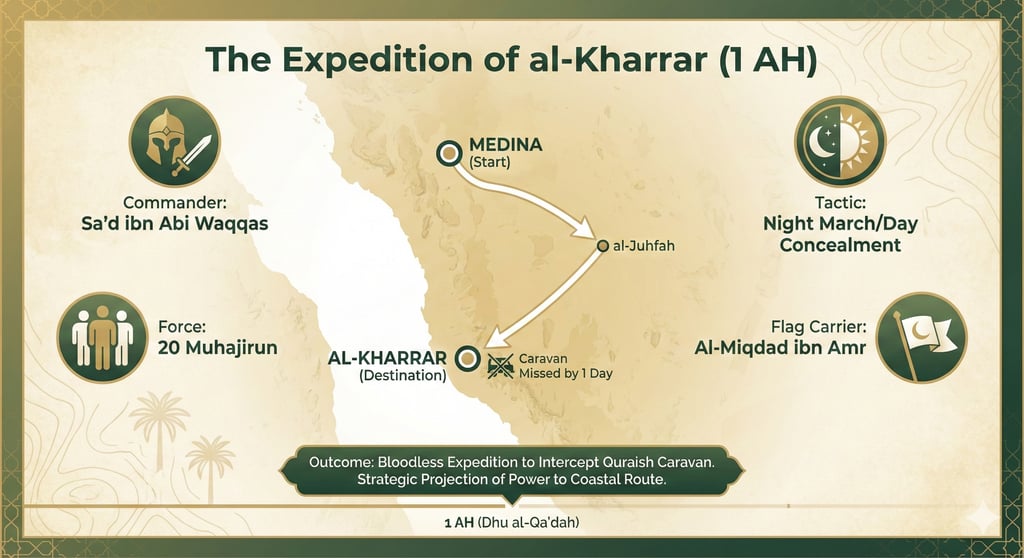
Troop Strength: The force comprised approximately twenty men (Al-Dhahabi, 1987, Vol. 2, p. 73).
Mode of Transport: The sources indicate that the troop moved primarily on foot (rajjal), emphasizing the stealth and endurance required for the mission (Al-Dhahabi, 1987, Vol. 2, p. 73).
3. Operational Tactics and Route
The primary objective of the expedition was to intercept a caravan belonging to the Quraish. To maintain the element of surprise and avoid detection by Bedouin tribes loyal to Mecca, Sa’d ibn Abi Waqqas employed specific stealth tactics:
Concealment: The unit operated under a strict protocol of hiding during the day and traveling by night (yakmunun al-nahar wa-yasirun al-layl) (Ibn Kathir, 1932, Vol. 3, p. 246; Al-Dhahabi, 1987, Vol. 2, p. 73).
The Banner: The Prophet (PBUH) assigned a white flag (liwa’ abyad) to the expedition. This standard was carried by Al-Miqdad ibn ‘Amr (Ibn Kathir, 1932, Vol. 3, p. 246).
3.1 Geographical Destination
The destination of the expedition was a location known as al-Kharrar. Classical geographers and historians locate this area near al-Juhfah and Khamm, significant waypoints on the route between Mecca and Medina (Al-Dhahabi, 1987, Vol. 2, p. 73).
4. Outcome of the Expedition
Upon arriving at al-Kharrar on the morning of the fifth day of their march, the Muslim detachment discovered that their intelligence regarding the caravan's timing was slightly delayed. The Quraish caravan had passed the location one day prior to their arrival (Ibn Kathir, 1932, Vol. 3, p. 246; Al-Dhahabi, 1987, Vol. 2, p. 73).
Consequently, the expedition returned to Medina without engaging in combat. Although the immediate objective of interception was not met, the operation successfully demonstrated the reach of the Muslim forces to al-Kharrar, a strategic point on the coastal trade route.
5. Conclusion
The Expedition of al-Kharrar, while bloodless, was a significant operational exercise for the early Muslim community. It established the capability of the Muhajirun to deploy small, mobile units deep into strategic territory (near al-Juhfah) and codified early military protocols such as nocturnal marching for concealment. The narratives provided by Al-Dhahabi and Ibn Kathir confirm that this event was a pivotal component of the security apparatus established by the Prophet (PBUH) in the months immediately following the Hijra.
References
Al-Dhahabi, S. (1987). Tarikh al-Islam wa Wafayat al-Mashahir wa al-A'lam (Vol. 2). (O. A. Tadmuri, Ed.). Beirut: Dar al-Kitab al-Arabi. [Source File: تاريخ الإسلام - ت تدمري_Volume_002.pdf]
Ibn Kathir, I. (1932). Al-Bidaya wa al-Nihaya (Vol. 3). Cairo: Matba'at al-Sa'adah. [Source File: البداية والنهاية - ط السعادة_Volume_003.pdf]