
The Expedition of Al-Raji: A Historical Analysis of Betrayal and Martyrdom
The Expedition of Al-Raji (Arabic: سرية الرجيع) represents a significant event in the early history of Islam, characterizing the period of military and diplomatic maneuvering between the Battle of Uhud and the Battle of the Trench. This research article reconstructs the events of the expedition, the geographical context, the treachery of the tribes involved, and the subsequent martyrdom of the Muslim scouts, based on specific historical manuscripts and biographical texts.
THE MILITARY HISTORY OF THE SEERAHSEERAHPOLITICSMILITARYHISTORY
Abdur Sami
1/7/20263 min read
1. Chronology and Context
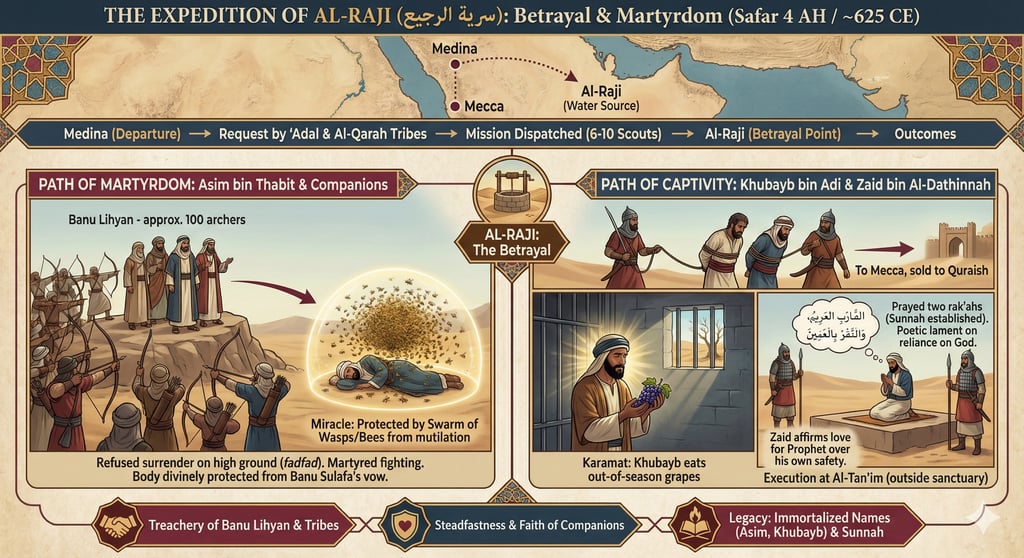
Historical sources generally place the Expedition of Al-Raji in the month of Safar during the fourth year of the Hijra (4 AH) (Al-Zahrani, n.d.-a; Al-Sulami, 2003). However, some discrepancies exist in early historiography, with certain scholars suggesting it occurred in the third year of the Hijra (Al-Samhudi, n.d.). This mission was dispatched by the Prophet Muhammad (peace be upon him) during a period of heightened tension with the tribes surrounding Medina and Mecca.
2. The Mission and Leadership
The catalyst for the expedition was a request made by a delegation from the tribes of ‘Adal and Al-Qarah. They approached the Prophet claiming that Islam had spread among them and requested instructors to teach them the Qur'an and Islamic laws (Ibn Kathir, 1998).
In response, the Prophet dispatched a group of his companions. Historians differ on the exact number of the scouts; some accounts state they were six men, while others, such as Al-Bukhari, state they were ten. The leadership of the group is also debated between Asim bin Thabit (the grandfather of Asim bin Umar bin Al-Khattab) and Marthad bin Abi Marthad Al-Ghanawi (Ibn Kathir, 1998).
3. Geographical Location: Al-Raji
The location of the incident, Al-Raji, is identified geographically as a water source belonging to the Hudhail tribe (Al-Bakri, n.d.). It is situated between Mecca and Al-Ta'if (Al-Samhudi, n.d.). Specifically, scholars have noted it is near Al-Watiyah, though distinct from the Al-Raji located near Khaybar (Al-Samhudi, n.d.).
4. The Betrayal at Al-Raji
The expedition proceeded until they reached the water of Al-Raji. Here, the delegation that had invited them betrayed the Muslims, calling upon the Banu Lihyan (a sub-branch of Hudhail) for assistance. The Muslims were resting and eating dates when their location was compromised. According to historical narratives, the pits of the dates they discarded were identified by the locals as "dates of Yathrib" (Medina), which alerted the Banu Lihyan to their presence (Al-Samhudi, n.d.).
The Banu Lihyan surrounded the Muslims with approximately one hundred archers. The Muslims took refuge on a high ground (fadfad). The attackers offered a covenant: if the Muslims surrendered, they would not be killed. Asim bin Thabit, the leader, refused to accept a covenant from polytheists or to descend, engaging in combat until he was martyred along with several companions (Ibn Kathir, 1998).
5. The Miracle of Asim bin Thabit
Following Asim's death, the Quraish, specifically the Banu Sulafa, sought to mutilate his body. Asim had previously killed a notable figure of theirs, and a vow had been made to drink wine from his skull. However, divine intervention is recorded in the sources; a swarm of wasps (or bees) protected Asim’s body, preventing the polytheists from approaching or severing his head (Ibn Kathir, 1998).
6. The Captivity and Execution of Khubayb
Three of the Muslims—Khubayb bin Adi, Zaid bin Al-Dathinnah, and a third man—initially accepted the offer of safety and surrendered. However, once they were bound, the third man recognized the treachery and refused to proceed; he was killed on the spot. Khubayb and Zaid were taken to Mecca and sold to the Quraish to be executed in revenge for the losses at the Battle of Badr (Ibn Kathir, 1998).
6.1. Khubayb’s Karamat (Miracles) During his imprisonment, the daughter of Al-Harith bin Amir (his captor) reported seeing Khubayb eating a bunch of grapes at a time of year when no fruit was available in Mecca, attributing this provision directly to God (Ibn Kathir, 1998).
6.2. The Execution When the Quraish took Khubayb to Al-Tan'im (outside the sanctuary boundaries) for execution, he requested permission to pray two rak'ahs. He performed them briefly, stating that he would have prolonged them had he not feared they would think he was stalling out of fear of death. This act established the tradition (Sunnah) of praying two rak'ahs before execution for Muslims killed in captivity (Ibn Kathir, 1998).
Before his death, Khubayb recited poetry lamenting his isolation but expressing his reliance on God, stating he did not care on which side he fell as long as it was for the sake of Allah. The Quraish also interrogated Zaid bin Al-Dathinnah, asking if he wished Muhammad was in his place while he was safe with his family. Zaid replied that he would not wish for the Prophet to be pricked by a thorn in exchange for his own safety (Ibn Kathir, 1998).
Conclusion
The Expedition of Al-Raji highlights the perils faced by early Muslim missionaries and the intense hostility of the tribes surrounding Medina. It serves as a historical record of the treachery of the Banu Lihyan and the steadfastness of the Companions, immortalizing the names of Asim bin Thabit and Khubayb bin Adi in Islamic history.
References
Al-Bakri, A. (n.d.). Mu'jam Ma Ista'jam min Asma' al-Bilad wa al-Mawadi' (Vol. 3).
Al-Dhahabi, S. (n.d.). Tarikh al-Islam (Vol. 2).
Al-Samhudi, A. (n.d.). Wafa' al-Wafa bi Akhbar Dar al-Mustafa (Vol. 4).
Al-Sulami, A. (2003). Marwiyat al-Imam al-Zuhri fi al-Maghazi (Vol. 1).
Al-Zahrani, M. (n.d.-a). Marwiyat Ghazwat Hunayn wa Hisar al-Ta'if (Vol. 1).
Ibn Kathir, I. (1998). Al-Bidaya wa'l-Nihaya (Vol. 4).