
The Expedition of Dhu Amarr: A Strategic Preemptive Strike in Najd
The Raid on Dhu Amarr, also known as the Raid of Ghatafan, represents a significant military maneuver led by the Prophet Muhammad (peace be upon him) in the early Medinan period. Occurring shortly after the invasion of Sawiq, this expedition was a preemptive strike aimed at the Bedouin tribes of Najd—specifically Banu Tha’labah and Banu Muharib—who were mobilizing to attack the outskirts of Medina. This article synthesizes historical data regarding the chronology, mobilization, intelligence gathering, and the pivotal encounter between the Prophet and the tribal leader Da’thur ibn al-Harith.
THE MILITARY HISTORY OF THE SEERAHSEERAHPOLITICSMILITARYHISTORY
Abdur Sami
1/4/20263 min read
1. Chronology and Context
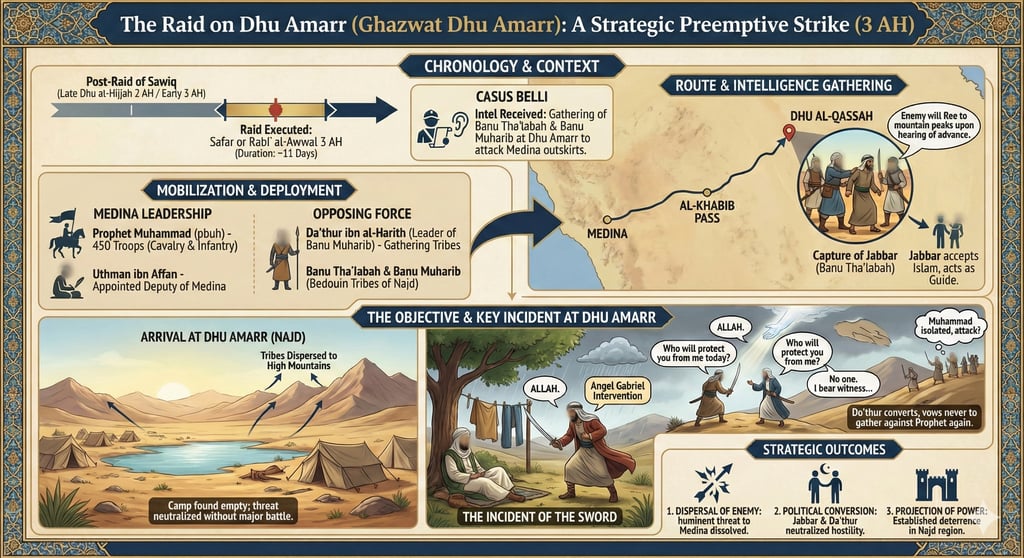
Historians differ slightly regarding the exact dating of this expedition, though there is consensus that it occurred in the third year after the Hijrah (3 AH), following the Raid of Sawiq.
According to Ibn Ishaq: The Prophet remained in Medina for the remainder of Dhu al-Hijjah (after Sawiq) or shortly thereof, and launched the campaign in the month of Safar, staying in Najd for nearly the entire month (Ibn Hisham, Vol. 2, p. 46; Ibn Sayyid al-Nas, Vol. 1, p. 355).
According to Al-Waqidi: The expedition commenced on Thursday, the 12th of Rabi' al-Awwal, 25 months after the Hijrah. The Prophet was absent from Medina for eleven days (Al-Waqidi, Vol. 1, p. 193; Al-Salihi, Vol. 4, p. 170).
The primary casus belli was intelligence reaching Medina that a gathering of Banu Tha’labah and Banu Muharib had assembled at Dhu Amarr—a water source in the Najd region—with the intent of raiding the outskirts of Medina (Al-Salihi, Vol. 4, p. 170).
2. Mobilization and Leadership
Upon receiving intelligence of the gathering, the Prophet mobilized a force of 450 Muslims. This force included both cavalry and infantry (Al-Waqidi, Vol. 1, p. 193).
Succession in Medina: Before departing, the Prophet appointed Uthman ibn Affan as his deputy to govern Medina in his absence (Ibn Hisham, Vol. 2, p. 46; Ibn Sayyid al-Nas, Vol. 1, p. 355).
Enemy Leadership: The opposing forces were led by a man named Da’thur ibn al-Harith (referred to as Ghawrath in some narrations, though Ibn Sayyid al-Nas identifies him as Da’thur) from the tribe of Banu Muharib (Al-Salihi, Vol. 4, p. 170).
3. Intelligence and the Capture of Jabbar
The Muslim army advanced through the pass of al-Khabib towards Dhu al-Qassah. It was at Dhu al-Qassah that the Muslim vanguard captured a man named Jabbar from the Banu Tha’labah tribe.
When interrogated about the location of the enemy, Jabbar revealed critical intelligence. He informed the Prophet that the tribes, upon hearing of the Muslim advance, would likely flee to the peaks of the mountains. He stated: "They will not meet you; if they heard of your march, they would have fled to the tops of the mountains" (Al-Waqidi, Vol. 1, p. 193; Al-Salihi, Vol. 4, p. 170).
Jabbar was invited to Islam by the Prophet, accepted the faith, and subsequently served as a guide for the Muslim army to the enemy's encampment (Al-Waqidi, Vol. 1, p. 193).
4. Arrival at Dhu Amarr and Enemy Reaction
Guided by Jabbar, the Muslim forces arrived at the water of Dhu Amarr. As predicted, the news of the Prophet's approach had caused the gathered tribes of Tha’labah and Muharib to scatter into the high mountains for safety. The Muslims found the campsite deserted and camped there, effectively neutralizing the threat without a large-scale engagement (Ibn Sayyid al-Nas, Vol. 1, p. 355).
5. The Incident of the Sword
A notable event recorded in the manuscripts occurred during this expedition involving the enemy leader, Da’thur ibn al-Harith.
Heavy rain fell upon the valley, soaking the Prophet’s garments. He separated from the main army to dry his clothes, hanging them on a tree and lying down to rest beneath it. Perceiving the Prophet's isolation, the Bedouins on the mountain urged Da’thur to attack, saying, "Muhammad has isolated himself, so move against him."
Da’thur approached with a drawn sword and stood over the Prophet, asking, "O Muhammad, who will protect you from me today?" The Prophet replied with absolute certainty: "Allah."
According to the narration, at that moment, the Angel Gabriel struck Da’thur in the chest, causing the sword to fall from his hand. The Prophet seized the sword and asked Da’thur, "Who will protect you from me?" Da’thur replied, "No one, and I bear witness that there is no god but Allah and that Muhammad is the Messenger of Allah. By Allah, I will never gather a group against you again."
The Prophet returned his sword to him. When Da’thur returned to his people, they asked why he had failed despite having the upper hand. He described seeing a tall man (Gabriel) who struck him, causing his collapse. Da’thur subsequently began inviting his people to Islam (Al-Waqidi, Vol. 1, p. 193; Al-Salihi, Vol. 4, p. 171; Ibn Sayyid al-Nas, Vol. 1, p. 355).
6. Outcome and Conclusion
The expedition of Dhu Amarr concluded without a pitched battle but achieved significant strategic and political objectives:
Dispersal of the Enemy: The imminent threat to Medina was dissolved as the tribes scattered.
Political Conversion: The conversion of Jabbar and the neutralization of the leader Da’thur weakened the hostility of the Ghatafan sub-tribes.
Projection of Power: The raid demonstrated the reach of the Medinan state into Najd, establishing deterrence against future Bedouin raids.
The Prophet returned to Medina after an absence of eleven days (according to Al-Waqidi) or having spent the month of Safar in Najd (according to Ibn Ishaq), encountering no further resistance (Ibn Hisham, Vol. 2, p. 46).
References
Al-Salihi, M. (n.d.). Subul al-Huda wa al-Rashad fi Sirat Khayr al-Ibad (Vol. 4).
Al-Waqidi, M. (n.d.). Kitab al-Maghazi (Vol. 1).
Ibn Hisham, A. (1955). Al-Sirah al-Nabawiyyah (M. Al-Saqqa, Ed., 2nd ed., Vol. 2). Mustafa al-Babi al-Halabi.
Ibn Sayyid al-Nas, M. (n.d.). Uyun al-Athar fi Funun al-Maghazi wa al-Shamail wa al-Siyar (Vol. 1).