
The Expedition of Hamza ibn Abd al-Muttalib: The First Banner of Islam
The Expedition (Sariyyah) of Hamza ibn Abd al-Muttalib represents a foundational moment in the military history of Islam. Occurring in the first year of the Hijrah, this mission marked the first time the Prophet Muhammad (peace be upon him) formally organized a military detachment to assert the presence of the nascent Islamic state and challenge the economic lifelines of the Quraysh. This article explores the details of the expedition, the strategic context, the opposing forces, and the historical scholarly discourse regarding its primacy over other expeditions.
SEERAHPOLITICSHISTORYMILITARYTHE MILITARY HISTORY OF THE SEERAH
Abdur Sami
12/28/20253 min read
Chronology and Leadership
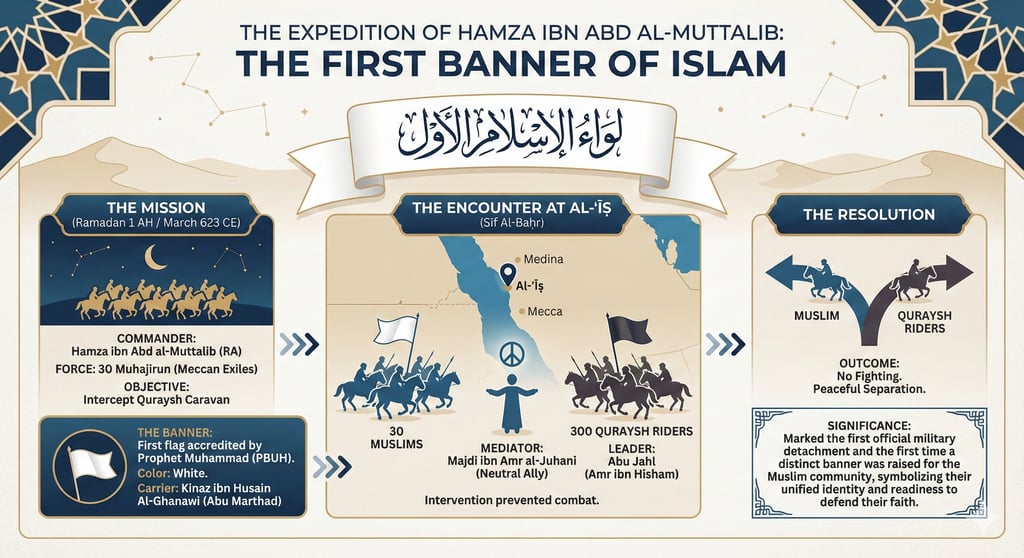
The expedition took place in the month of Ramadan, roughly seven months after the Prophet’s migration (Hijrah) to Medina. It is recorded as the first banner ever tied by the Messenger of God, symbolizing the formal commencement of military operations against the polytheists of Mecca (Al-Dhahabi, Tārīkh al-Islām; Ibn Kathir, Al-Bidayah wa al-Nihayah).
The Prophet (peace be upon him) appointed his uncle, Hamza ibn Abd al-Muttalib (may Allah be pleased with him), as the commander of this detachment. To signify his authority, the Prophet tied for him a white banner, which was carried by Abu Marthad Kannaz ibn Husayn al-Ghanawi, a strategic ally and companion (Ibn Hisham, Al-Sirah al-Nabawiyyah).
Objectives and Strategic Location
The primary objective of this expedition was to intercept a commercial caravan belonging to the Quraysh, which was returning from the Levant (Al-Sham) en route to Mecca. This move was intended to exert economic pressure on the Quraysh, who relied heavily on these trade routes for their livelihood and influence.
The expedition marched towards a location known as Sif al-Bahr (the seacoast), specifically in the region of al-‘Is, which lies within the territory of the Juhaynah tribe. This coastal route was a critical artery for Meccan trade (Al-Dhahabi, Tārīkh al-Islām).
Composition of Forces
The Muslim Detachment
Hamza ibn Abd al-Muttalib led a force comprised of thirty riders. A distinct characteristic of this expedition was that it consisted entirely of the Muhajirun (Emigrants from Mecca). No members of the Ansar (Helpers of Medina) participated, as the Prophet had not yet called upon them to fight outside their city boundaries at this early stage (Ibn Kathir, Al-Bidayah wa al-Nihayah).
The Opposing Force
The Meccan caravan was guarded by a formidable force commanded by Abu Jahl ibn Hisham, one of the staunchest enemies of Islam. Historical accounts vary slightly regarding the number of polytheists guarding the caravan; some reports state there were three hundred riders, while others suggest numbers around one hundred and thirty. Regardless of the exact figure, the Meccan force significantly outnumbered the Muslim detachment (Al-Dhahabi, Tārīkh al-Islām).
The Encounter and Mediation
The two forces met at the specified location and lined up, poised for battle. However, actual combat was averted due to the diplomatic intervention of a local tribal leader, Majdi ibn Amr al-Juhani.
Majdi held a unique position as a mutual ally (halif) to both parties; he had treaties with the Muslims and the Quraysh. Utilizing his influence, he moved between the two camps, mediating and dissuading them from engaging in bloodshed. His efforts were successful, and the two armies disengaged without a single arrow being fired or a sword being drawn. Abu Jahl proceeded to Mecca with his caravan, and Hamza returned to Medina with his men (Ibn Hisham, Al-Sirah al-Nabawiyyah; Al-Dhahabi, Tārīkh al-Islām).
Historical Scholarly Discourse: The First Banner
Scholars of Siyar (biography) and Maghazi (expeditions) have debated whether Hamza’s expedition or that of Ubaydah ibn al-Harith was the absolute first in Islam.
The Case for Hamza: Many sources, including reports from Ibn Ishaq (with reservations) and affirmations by later historians, cite Hamza’s expedition as the first because his banner was the first one formally tied by the Prophet.
The Case for Ubaydah: Some scholars argue that the expedition of Ubaydah ibn al-Harith to Rabigh occurred slightly earlier or simultaneously, leading to confusion.
To resolve this, Ibn Ishaq mentions verses of poetry attributed to Hamza ibn Abd al-Muttalib, in which he claims the honor of the first banner:
"By the command of the Messenger of God, the first waving banner / over me, meant for victory from a Possessor of Dignity."
However, Ibn Hisham notes that many scholars of poetry question the authenticity of these verses being attributed to Hamza (Ibn Hisham, Al-Sirah al-Nabawiyyah).
Conclusion
The Expedition of Hamza ibn Abd al-Muttalib, though bloodless, established the Muslims as a rising power capable of threatening Quraysh's vital trade routes. It demonstrated the strategic reach of the state in Medina and set the stage for the major confrontations that would follow, such as the Battle of Badr.
References
Al-Dhahabi, S. D. (1993). Tārīkh al-Islām wa Wafayāt al-Mashāhīr wa al-A'lām (Vol. 2, Al-Maghazi). Dar al-Kitab al-Arabi.
Ibn Hisham, A. M. (1955). Al-Sirah al-Nabawiyyah (Vol. 1). Mustafa al-Babi al-Halabi.
Ibn Kathir, I. (1988). Al-Bidayah wa al-Nihayah (Vol. 3). Dar Ihya al-Turath al-Arabi.