The Expedition of Qatan (Sariyya Abu Salamah)
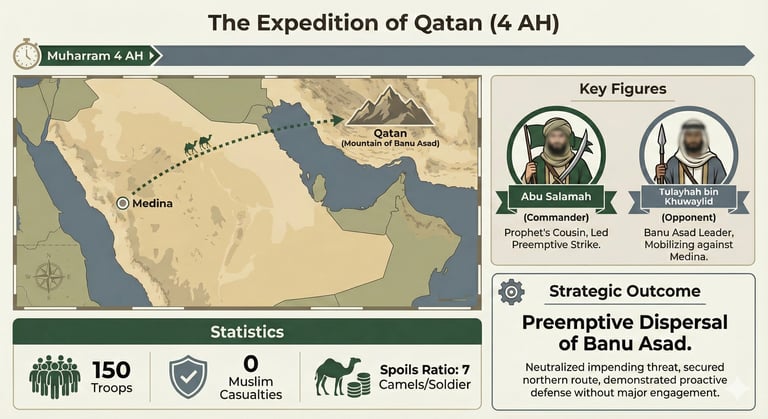
The Expedition of Qatan, led by Abu Salamah bin Abd al-Asad in the month of Muharram, 4 AH, represents a significant preemptive military operation in early Islamic history. Directed against the Banu Asad bin Khuzaymah, who were mobilizing under Tulayhah bin Khuwaylid to attack Medina, this expedition demonstrates the strategic shift towards proactive defense following the Battle of Uhud. This article synthesizes historical data from classical manuscripts to reconstruct the event's timeline, geography, and outcomes.
THE MILITARY HISTORY OF THE SEERAHSEERAHMILITARYPOLITICSHISTORY
Abdur Sami
1/6/20263 min read
1. Historical Context and Dating The Expedition of Qatan occurred at the beginning of the thirty-fifth month after the Hijra of the Prophet Muhammad (peace be upon him) to Medina. This corresponds to the month of Muharram in the fourth year of the Hijra (Al-Waqidi, Vol. 1; Al-Dhahabi, Vol. 2). This period marked a time of heightened vigilance for the Muslim community following the events of Uhud.
2. Geographical Location Qatan is identified geographically as a mountain located within the territory of the Banu Asad tribe. It sits in the direction of Fayd, a notable location on the pilgrimage route (Shurrab, Al-Ma'alim al-Athirah). Al-Waqidi describes the destination of the Muslim army specifically as the "water of Qatan" belonging to the Banu Asad (Al-Waqidi, Vol. 1).
3. Causes and Mobilization The primary catalyst for this expedition was intelligence received by the Prophet regarding hostile movements by the Banu Asad. A man from the Banu Tayy tribe arrived in Medina and informed the Prophet that Tulayhah bin Khuwaylid and his brother, Salamah bin Khuwaylid, were rallying their people and allies with the specific intent of launching an attack against the Prophet and the Muslim community (Al-Waqidi, Vol. 1).
Acting on this intelligence, the Prophet commissioned Abu Salamah bin Abd al-Asad—who was the Prophet's foster brother (through nursing) and cousin—to lead a force to intercept the threat. The Prophet entrusted Abu Salamah with a banner (Liwa) and issued explicit strategic orders: "March until you land on their territory, and engage them before they can reach me" (Al-Waqidi, Vol. 1).
4. Composition of the Force The detachment consisted of approximately 150 men, comprised of individuals from both the Muhajireen (Emigrants) and the Ansar (Helpers). Among the notable participants mentioned in the chronicles were Usaid bin al-Hudayr and Abbad bin Bishr (Al-Waqidi, Vol. 1).
5. The Campaign Abu Salamah led his troops out of Medina, utilizing a guide from the Banu Tayy to navigate a non-standard route, thereby maintaining the element of surprise. They marched until they reached the vicinity of Qatan.
Upon arrival, the Muslim force captured a shepherd belonging to the Banu Asad. After interrogation, the shepherd revealed the location of the enemy encampment. However, upon hearing of the Muslim army's approach and their proximity, the forces of Tulayhah dispersed and fled, failing to engage in direct combat. The element of surprise had successfully disrupted the Banu Asad's mobilization (Al-Waqidi, Vol. 1; Al-Dhahabi, Vol. 2).
6. Operations and Spoils Although the main enemy force fled, Abu Salamah divided his troops into three smaller raiding parties (saraya)—one group of seven, another of seven, and a third of eight men—to secure the area and collect spoils. These groups successfully rounded up livestock left behind by the fleeing tribe.
The spoils secured were significant, consisting of camels and sheep (al-Sha'). Upon the expedition's conclusion, the spoils were distributed among the soldiers. The share for each participant was calculated at seven camels per man, with the sheep being equated to camels in value for the distribution (Al-Waqidi, Vol. 1).
7. Return and Aftermath Abu Salamah remained in the territory for a day or night before commencing the return journey to Medina. He returned victorious without having suffered casualties in battle.
However, the physical toll of the expedition had severe personal consequences for the commander. Abu Salamah had previously been wounded at the Battle of Uhud by an arrow shot by Abu Usamah al-Jushami. Although the wound had appeared to heal, the exertion of the Expedition of Qatan caused it to reopen (intaqada). This led to a deterioration in his health, and he passed away shortly thereafter, in Jumada al-Ula of the same year (4 AH) (Al-Waqidi, Vol. 1; Al-Dhahabi, Vol. 2).
8. Conclusion The Expedition of Qatan serves as a case study in early Islamic military strategy, highlighting the importance of intelligence gathering and preemptive strikes to disperse gathering threats. It effectively neutralized the danger posed by the Banu Asad in the year 4 AH, securing Medina's safety without a major pitched battle.
References
Al-Dhahabi, S. (1993). Tarikh al-Islam wa Wafiyat al-Mashahir wa al-A'lam (Vol. 2). (U. A. Tadmuri, Ed.). Dar al-Kitab al-Arabi.
Al-Waqidi, M. (1989). Kitab al-Maghazi (Vol. 1). (M. Jones, Ed.). Dar al-A'lami.
Shurrab, M. (1991). Al-Ma'alim al-Athirah fi al-Sunnah wa al-Sirah. Dar al-Qalam.