
The Expedition of Ubaydah ibn al-Harith (Sariyyah Batn Rabigh)
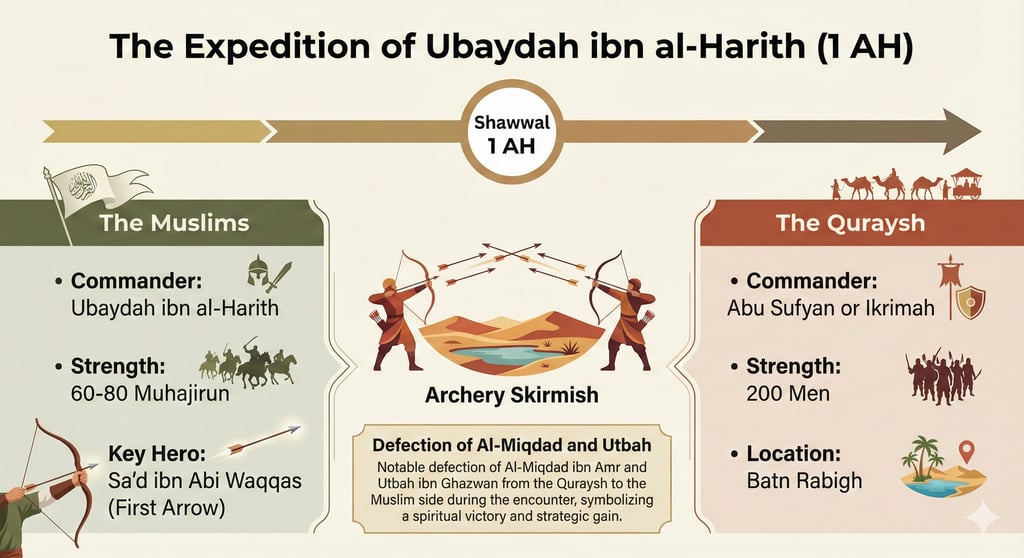
The Expedition of Ubaydah ibn al-Harith, also known as the Expedition of Batn Rabigh, represents one of the earliest military detachments (Sariyyah) dispatched by the Prophet Muhammad (peace be upon him) after the Hijrah. According to the chronology of the Maghazi, this expedition occurred in the month of Shawwal, eight months after the Prophet's migration to Medina (Al-Waqidi, Al-Maghazi; Al-Salihi, Subul al-Huda). Some historians consider it the second expedition in Islam, following that of Hamza ibn Abd al-Muttalib, while others debate the order.
SEERAHPOLITICSMILITARYHISTORYTHE MILITARY HISTORY OF THE SEERAH
Abdur Sami
12/28/20252 min read
Leadership and Composition
The Muslim Force: The Prophet (peace be upon him) appointed Ubaydah ibn al-Harith ibn al-Muttalib (may Allah be pleased with him) as the commander of this detachment. He was entrusted with a white banner, which was carried by Mistah ibn Uthatha (Al-Salihi, Subul al-Huda).
The force consisted of sixty to eighty horsemen, all drawn exclusively from the Muhajirun (Emigrants). No members of the Ansar (Helpers) participated in this expedition (Al-Salihi, Subul al-Huda; Ibn Hisham, Al-Sirah).
The Opposing Force: The Muslim detachment encountered a large caravan of the Quraysh at a water source called Ahya' in the valley of Rabigh, approximately ten miles from Al-Juhfah. The Quraysh force consisted of 200 men.
There is a historical divergence regarding the leader of the Quraysh caravan:
Al-Waqidi asserts that the leader was Abu Sufyan ibn Harb, stating, "This is the established view among us" (Al-Waqidi, Al-Maghazi).
Ibn Ishaq reports that the leader was Ikrimah ibn Abi Jahl, though he also mentions the possibility of it being Mikraz ibn Hafs (Ibn Hisham, Al-Sirah).
Military Engagement: The First Arrow of Islam
Upon making contact at Thaniyat al-Murra near Rabigh, the two parties did not engage in close-quarters combat, nor did they draw swords or organize into formal battle lines. instead, the engagement was limited to a skirmish involving archery (Munawashah).
A pivotal event occurred during this standoff involving Sa'd ibn Abi Waqqas (may Allah be pleased with him). He emptied his quiver, shooting approximately twenty arrows at the polytheists. Every arrow he fired reportedly hit a target, wounding either a man or a mount. Because of this feat, Sa'd is historically recognized as the "First to shoot an arrow in the cause of Allah" (Al-Waqidi, Al-Maghazi; Al-Salihi, Subul al-Huda).
Strategic Outcomes and Defections
Despite the numerical superiority of the Quraysh (200 vs. 60-80), the intensity of the Muslims' archery—and specifically the performance of Sa'd ibn Abi Waqqas—instilled fear in the opposing ranks. The Quraysh suspected that the small Muslim detachment served as a vanguard for a larger army and subsequently retreated to Mecca to protect their caravan, while the Muslims returned to Medina (Al-Salihi, Subul al-Huda).
Notable Defections: During the encounter, two men from the Quraysh ranks fled and joined the Muslims. They were:
Al-Miqdad ibn Amr (Al-Bahrani).
Utbah ibn Ghazwan. These two were Muslims who had been concealing their faith among the polytheists and utilized this expedition as an opportunity to defect and join the Prophet's companions (Ibn Hisham, Al-Sirah; Al-Salihi, Subul al-Huda).
Conclusion
The Expedition of Ubaydah ibn al-Harith concluded without direct bloodshed but achieved significant strategic objectives: it demonstrated the Muslims' reach to the Quraysh trade routes and facilitated the safe defection of key companions. It stands as a testament to the early military organization of the Islamic state and the individual prowess of companions like Sa'd ibn Abi Waqqas.
References
Al-Salihi, M. (n.d.). Subul al-Huda wa al-Rashad fi Sirat Khayr al-Ibad. [Uploaded Manuscript].
Al-Waqidi, M. (n.d.). Kitab al-Maghazi. [Uploaded Manuscript].
Ibn Hisham, A. (n.d.). Al-Sirah Al-Nabawiyyah.