
The First Expedition to Badr (Ghazwat Safwan)
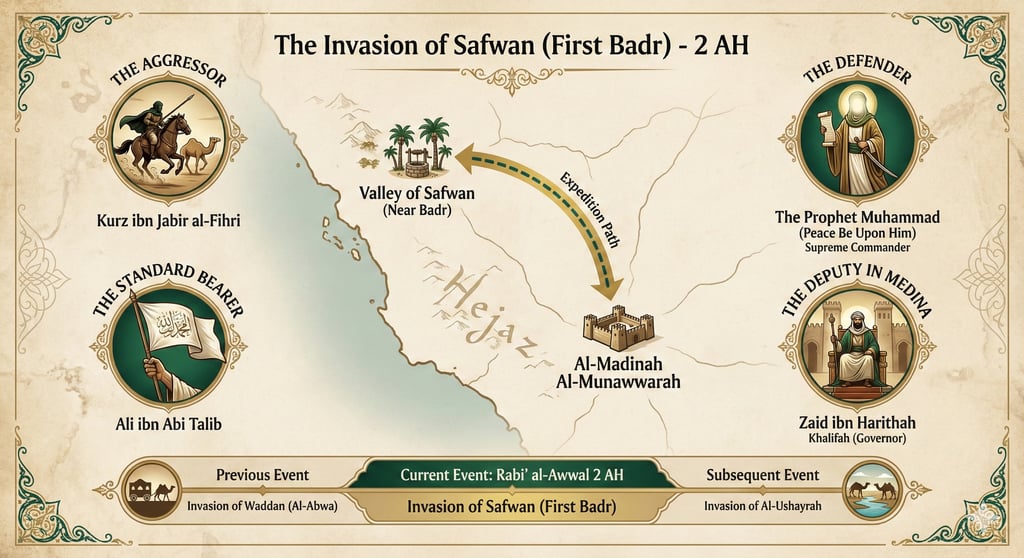
The First Expedition to Badr (Ghazwat Badr al-Ula), also commonly referred to in biographical literature as the Invasion of Safwan (Ghazwat Safwan), was a military sortie led personally by the Prophet Muhammad (peace be upon him) during the early period of the Medinan era. It is distinct from the Great Battle of Badr (Badr al-Kubra), which occurred later. Historians such as Ibn Hisham and Ibn Sayyid al-Nas explicitly categorize this event as the "First Badr" to distinguish it from the major confrontation with the Quraysh (Ibn Hisham, 1955; Ibn Sayyid al-Nas, 1993).
SEERAHPOLITICSMILITARYHISTORYTHE MILITARY HISTORY OF THE SEERAH
Abdur Sami
12/29/20252 min read
Chronology and Context
This expedition took place in the month of Rabi' al-Awwal, shortly after the Prophet's return from the expedition of Waddan (also known as Al-Abwa) and prior to the expedition of Al-Ushayrah (Al-Maqrizi, 1999; Ibn Hisham, 1955). It occurred in the second year of the Hijrah (migration to Medina).
Causes of the Expedition
The primary cause of this campaign was an act of aggression committed by a polytheist chieftain named Kurz ibn Jabir al-Fihri. According to the historical narratives, Kurz raided the grazing pastures of Medina (Hima al-Madinah) and seized camels and cattle belonging to the Muslims (Ibn Hisham, 1955). This raid on the Sarh (freely grazing livestock) necessitated an immediate response to protect the economic assets and territorial integrity of the newly formed Muslim state.
Military Mobilization and Leadership
Upon receiving news of the raid, the Prophet Muhammad (peace be upon him) mobilized a detachment of Muslims to pursue the aggressor. The following administrative and military appointments were made for this expedition:
Supreme Commander: The Prophet Muhammad (peace be upon him) led the pursuit personally.
Deputy in Medina: The Prophet appointed Zaid ibn Harithah (may Allah be pleased with him) as his deputy to govern Medina in his absence (Ibn Hisham, 1955; Ibn Sayyid al-Nas, 1993).
The Standard Bearer: The banner for this expedition was white, and it was carried by Ali ibn Abi Talib (may Allah be pleased with him) (Ibn Hisham, 1955; Al-Maqrizi, 1999).
The Pursuit and Outcome
The Muslim forces tracked Kurz ibn Jabir until they reached a valley known as Safwan, which is located in the vicinity of Badr. It is due to this geographical location that the event is named "The First Badr" (Ibn Hisham, 1955).
Despite the rapid mobilization, Kurz ibn Jabir al-Fihri managed to outpace the Muslim pursuers. The texts record that the Prophet (peace be upon him) "missed him" (Fatahuh), meaning the aggressor had fled before the Muslims could engage him. Consequently, no combat took place, and the Prophet returned to Medina without a military confrontation (Ibn Hisham, 1955; Ibn Sayyid al-Nas, 1993).
Historical Significance
While no fighting occurred, the First Expedition to Badr demonstrated the readiness of the Muslim state to defend its borders and assets. It also familiarized the Muslim forces with the terrain around Badr, which would become the site of the decisive "Great Battle of Badr" shortly thereafter. The designation of this event as "Badr al-Ula" (The First Badr) serves as a critical chronological marker in the Maghazi (military campaigns) literature, distinguishing preliminary maneuvers from major wars (Al-Maqrizi, 1999).
References
Al-Maqrizi, A. (1999). Imta' al-Asma' bima lil-Nabi min al-Ahwal wa al-Amwal wa al-Hafadah wa al-Mata'. (M. A. Namir, Ed.). Dar al-Kutub al-Ilmiyyah.
Ibn Hisham, A. (1955). Al-Sirah al-Nabawiyyah. (M. Al-Saqqa, I. Al-Abyari, & A. Shalabi, Eds.). Mustafa al-Babi al-Halabi.
Ibn Sayyid al-Nas, M. (1993). Uyun al-Athar fi Funun al-Maghazi wa al-Shamail wa al-Siyar. (I. M. Ramadan, Ed.). Dar al-Qalam.