
The Invasion of Buhran: A Historical Analysis from Classical Manuscripts
The Invasion of Buhran (Arabic: غزوة بحران) represents a significant preemptive military campaign led by the Prophet Muhammad (peace be upon him) in the third year of the Hijrah. This research article synthesizes historical data derived exclusively from classical Islamic manuscripts to provide a comprehensive account of the event, its causes, chronology, and outcomes.
THE MILITARY HISTORY OF THE SEERAHSEERAHPOLITICSMILITARYHISTORY
Abdur Sami
1/4/20262 min read
1. Chronology and Timing
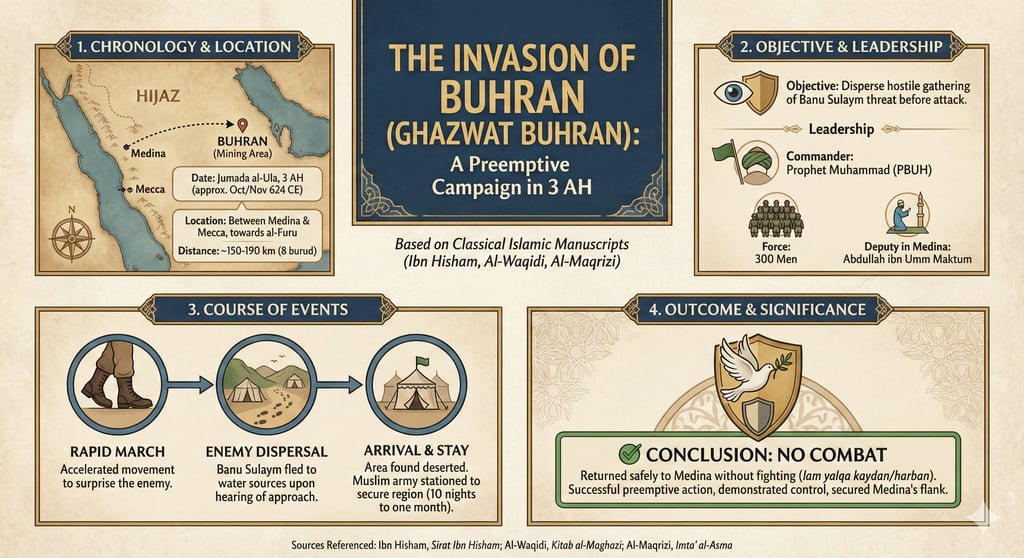
Primary sources present slight variations regarding the exact timing of the expedition, though they agree it occurred in the third year after the Hijrah (3 AH).
Ibn Ishaq's Account: According to Ibn Ishaq, as preserved by Ibn Hisham, the Prophet (PBUH) remained in Medina for the month of Rabi' al-Awwal and then set out for the campaign. He spent the months of Rabi' al-Akhir and Jumada al-Ula in Buhran before returning to Medina (Ibn Hisham, Sirat Ibn Hisham, Vol. 2, p. 46).
Al-Waqidi's Account: Muhammad ibn Umar al-Waqidi provides a more specific date, stating that the Prophet set out on the 6th of Jumada al-Ula, 3 AH (Al-Waqidi, Kitab al-Maghazi, Vol. 1, p. 196).
Al-Maqrizi's Synthesis: Al-Maqrizi aligns with Al-Waqidi’s dating, confirming the exit on the 6th of Jumada al-Ula (Al-Maqrizi, Imta' al-Asma', Vol. 1, p. 125).
2. Geographical Context
The target location, Buhran (بُحْرَان), is described in the manuscripts as a mining area (مَعْدِن) located in the Hijaz region.
It is situated in the direction of al-Furu' (الْفُرْع), a distinct area between Mecca and Medina (Ibn Hisham, Sirat Ibn Hisham, Vol. 2, p. 46).
Al-Waqidi notes the distance between Medina and Buhran as eight burud (approximately 150-190 km, depending on the estimation of a barid) (Al-Waqidi, Kitab al-Maghazi, Vol. 1, p. 196).
3. Causes and Objectives
The primary motivation for the campaign was intelligence regarding hostile movements by the tribe of Banu Sulaym.
Reports reached the Prophet (PBUH) that a large gathering of Banu Sulaym had assembled at Buhran, posing a potential threat to Medina (Al-Waqidi, Kitab al-Maghazi, Vol. 1, p. 196; Al-Maqrizi, Imta' al-Asma', Vol. 1, p. 125).
The objective was to disperse this gathering before they could launch an attack.
4. Military Composition and Leadership
The Army: The Muslim force consisted of 300 men (Al-Waqidi, Kitab al-Maghazi, Vol. 1, p. 196).
Leadership in Medina: Before departing, the Prophet (PBUH) appointed Abdullah ibn Umm Maktum as his deputy to govern Medina and lead the prayers in his absence (Ibn Hisham, Sirat Ibn Hisham, Vol. 2, p. 46; Al-Maqrizi, Imta' al-Asma', Vol. 1, p. 125).
5. Course of Events
The expedition was characterized by rapid movement but resulted in no direct combat.
The March: The Prophet (PBUH) accelerated his march towards Buhran to surprise the enemy.
Enemy Reaction: Upon hearing of the Muslim army's approach, the gathering of Banu Sulaym dispersed into their water sources and territories, fleeing before the Prophet's arrival.
Arrival and Stay: When the Muslim army arrived at Buhran, they found the area deserted. The Prophet (PBUH) remained stationed there for a period to secure the area and demonstrate control.
Al-Waqidi states the total absence from Medina was 10 nights (Al-Waqidi, Kitab al-Maghazi, Vol. 1, p. 196).
Ibn Ishaq indicates a longer stay, mentioning the months of Rabi' al-Akhir and Jumada al-Ula (Ibn Hisham, Sirat Ibn Hisham, Vol. 2, p. 46).
6. Outcome
The invasion concluded without any fighting ("did not meet any plot/war" - lam yalqa kaydan/harban). The Prophet (PBUH) and his companions returned safely to Medina (Ibn Hisham, Sirat Ibn Hisham, Vol. 2, p. 46).
References
Al-Maqrizi, A. (1999). Imta' al-Asma' bi-ma li-l-Nabi min al-Ahwal wa-l-Amwal wa-l-Hafadah wa-l-Mata'. Beirut: Dar al-Kutub al-Ilmiyah.
Al-Waqidi, M. (1989). Kitab al-Maghazi. (M. Jones, Ed.). Beirut: Dar al-A'lami.
Ibn Hisham, A. (1955). Al-Sirah al-Nabawiyyah. (M. Al-Saqqa, I. Al-Abyari, & A. Shalabi, Eds.). Cairo: Mustafa al-Babi al-Halabi.