
The Invasion of Hamra al-Asad: A Strategic Post-Uhud Deployment
This research article provides a detailed reconstruction of the Invasion of Hamra al-Asad (Ghazwat Hamra al-Asad), a military expedition led by the Prophet Muhammad (peace be upon him) immediately following the Battle of Uhud in Shawwal 3 AH (625 CE). Drawing exclusively from classical Islamic historiography—specifically the works of Ibn Ishaq, Ibn Hisham, Al-Waqidi, Ibn Sa'd, and Al-Tabari—this report analyzes the strategic objectives, psychological warfare tactics, and outcomes of the operation. The primary goal of this expedition was not direct combat, but rather the restoration of deterrence and the projection of military strength following the setback at Uhud.
THE MILITARY HISTORY OF THE SEERAHSEERAHPOLITICSMILITARYHISTORY
Abdur Sami
1/6/20263 min read
1. Historical Context and Mobilization
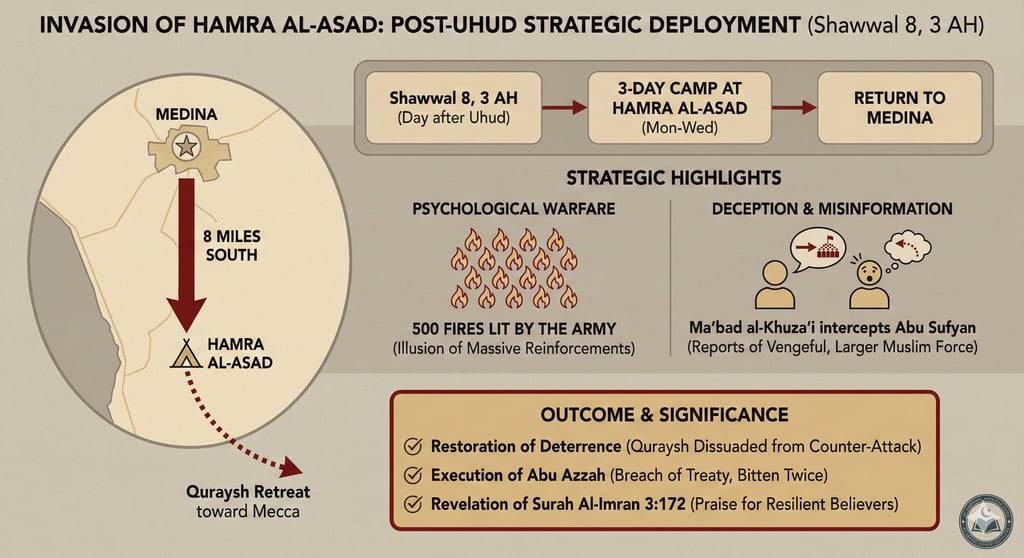
1.1 The Immediate Aftermath of Uhud The expedition was initiated on Sunday, the 8th of Shawwal, 3 AH, the very day following the Battle of Uhud (Al-Waqidi, 2011; Ibn Sa'd, 1972). Despite the severe injuries sustained by the Muslims and the physical exhaustion of the army, the Prophet Muhammad ordered a compilation of the forces to pursue the retreating Quraysh.
1.2 Criteria for Participation Classical manuscripts record a strict criterion for participation in this expedition: only those who had been present at the Battle of Uhud were permitted to join. The intent was to demonstrate that the very force which had suffered a setback was still capable of offensive action (Ibn Hisham, 1955).
1.3 The Exception of Jabir ibn Abdullah There was a singular exception to this rule found in the manuscripts. Jabir ibn Abdullah al-Ansari requested permission to join, stating that he had only remained behind at Uhud to care for his seven sisters upon his father's instruction. Recognizing his valid excuse and eagerness, the Prophet granted him permission to march (Ibn Hisham, 1955; Al-Waqidi, 2011).
2. Strategic Maneuvers and Psychological Warfare
2.1 Deployment to Hamra al-Asad The Muslim army, comprising roughly the same contingent that fought at Uhud, marched approximately eight to ten miles south of Medina to a location known as Hamra al-Asad. Upon arrival, the Prophet commanded the troops to kindle fires. Al-Waqidi (2011) notes that 500 fires were lit that night. The visual effect of these fires, visible from a distance, was intended to project the illusion of a massive reinforcement army to any observers or spies in the area.
2.2 The Role of Ma'bad al-Khuza'i A pivotal element of this expedition was the psychological operation facilitated by Ma'bad al-Khuza'i. At this time, Ma'bad was a polytheist but secretly sympathetic to the Prophet and his clan (Banu Khuza'ah had a standing alliance with Banu Hashim).
According to Ibn Ishaq and Al-Tabari (1987), Ma'bad encountered Abu Sufyan, the leader of the Quraysh, at an area called Al-Rawha. Abu Sufyan was debating whether to return to Medina to annihilate the remaining Muslims. Ma'bad, employing deception for strategic advantage, informed Abu Sufyan that Muhammad was in pursuit with a force of unprecedented size and rage ("hearts burning with anger"), including those who had initially stayed behind. This disinformation successfully struck fear into the Quraysh leadership, causing them to abandon their plans for a counter-attack and hasten their retreat to Mecca (Ibn Hisham, 1955).
3. Captured Hostages and Executions
3.1 The Case of Abu Azzah al-Jumahi During the operation, the Muslim forces captured Abu Azzah Amr bin Abd Allah al-Jumahi, a poet of the Quraysh. Abu Azzah had previously been captured at the Battle of Badr but was released without ransom by the Prophet on the condition that he would never again fight against the Muslims or use his poetry to incite war (Ibn Hisham, 1955).
Violating this oath, Abu Azzah had participated in Uhud and was found again among the enemy lines. When captured at Hamra al-Asad, he pleaded for mercy once more. The classical sources record the Prophet's response: "I will not let you stroke your beard in Mecca saying, 'I deceived Muhammad twice.'" It is in this context that the famous maxim is often cited: "A believer is not bitten from the same hole twice" (Ibn Hisham, 1955; Al-Tabari, 1987). Consequently, Abu Azzah was executed; sources differ on whether the executioner was Al-Zubayr ibn al-Awwam or Asim ibn Thabit (Al-Waqidi, 2011).
3.2 The Fate of the Spies Al-Waqidi (2011) also details that the Prophet had sent three spies from the Banu Aslam to track the Quraysh. Two of them were intercepted and killed by the retreating Meccan army at Hamra al-Asad before the main Muslim force arrived; the Muslims later found their bodies at the site.
4. Outcome and Significance
The army remained at Hamra al-Asad for three days (Monday through Wednesday) before returning to Medina. No major battle took place, yet the objectives were fully achieved:
Deterrence: The Quraysh were dissuaded from returning to Medina.
Morale: The operation restored confidence within the Muslim ranks, proving their resilience immediately after a traumatic loss.
Revelation: Classical exegetes link verses 3:172-175 of the Qur'an to this event, praising "Those who answered the call of Allah and the Messenger after being wounded" (Al-Tabari, 1987).
References
Al-Tabari, M. ibn Jarir. (1987). The History of al-Tabari: The Foundation of the Community (Vol. 7). (W. M. Watt & M. V. McDonald, Trans.). State University of New York Press.
Al-Waqidi, M. ibn Umar. (2011). The Life of Muhammad: Al-Waqidi’s Kitab al-Maghazi. (R. Faizer, Trans.). Routledge.
Ibn Hisham, A. M. (1955). The Life of Muhammad: A Translation of Ishaq’s Sirat Rasul Allah. (A. Guillaume, Trans.). Oxford University Press.
Ibn Sa'd, M. (1972). Kitab al-Tabaqat al-Kabir (Vol. 2). (S. M. Haq, Trans.). Pakistan Historical Society.