
The Invasion of Sawiq (Ghazwat al-Sawiq)
Date of the Event: 5th of Dhu al-Hijjah, 2 AH (approx. 22 months after the Hijra) Location: Al-Urayd (a valley near Medina) and the route towards Mecca. Belligerents: The Muslims led by Prophet Muhammad (ﷺ) vs. The Quraysh led by Abu Sufyan ibn Harb.
THE MILITARY HISTORY OF THE SEERAHSEERAHPOLITICSMILITARYHISTORY
Abdur Sami
12/29/20252 min read
1. Introduction and Causes
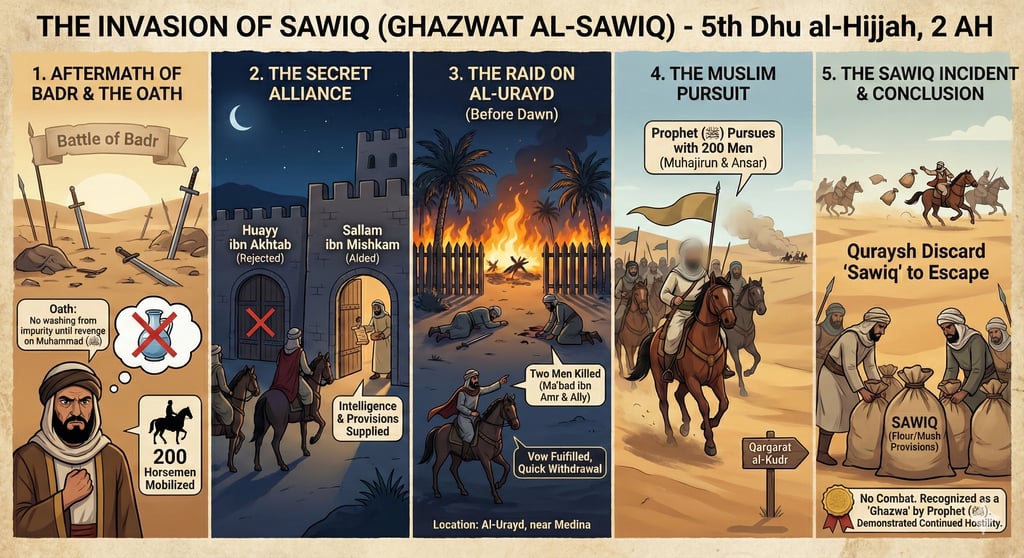
The Invasion of Sawiq occurred approximately two months after the Battle of Badr. Following the significant defeat of the Quraysh at Badr and the return of their remnants to Mecca, Abu Sufyan ibn Harb made a solemn vow. He swore that he would not let water touch his head from major impurity (Janaba)—meaning he would refrain from washing or sexual relations—until he had raided Muhammad (ﷺ) to exact revenge.
2. The Mobilization of Quraysh
To fulfill his oath, Abu Sufyan set out from Mecca with a force of 200 horsemen (some sources say 40) to conduct a surprise raid on Medina. He navigated the Nejd route until he reached an area called Najdiyyah, settling near Mount Thayb, approximately one post-stage (barid) or about twelve miles from Medina.
3. The Collaboration with Banu al-Nadir
Upon arriving at night to maintain secrecy, Abu Sufyan sought intelligence and support from the Jewish tribes in Medina.
Huayy ibn Akhtab: Abu Sufyan first approached the fortress of Huayy ibn Akhtab (of Banu al-Nadir) and knocked on his door. Huayy, fearing the consequences, refused to open the door for him.
Sallam ibn Mishkam: Abu Sufyan then proceeded to Sallam ibn Mishkam, who was the treasurer and a prominent leader of Banu al-Nadir. Sallam welcomed him, hosted him, provided food and drink, and crucially, supplied him with secret intelligence regarding the Muslims and the situation in Medina.
4. The Raid on Al-Urayd
Before dawn, Abu Sufyan left Sallam's fortress and dispatched a group of his men to Al-Urayd, a valley near Medina. There, they executed the raid to fulfill the technicality of Abu Sufyan's oath:
They burned several date-palm fences (Aswar).
They encountered an Ansari man named Ma'bad ibn Amr and his ally (or laborer) who were in the fields. The Quraysh attackers killed both men.
Satisfied that he had "raided" and fulfilled his vow, Abu Sufyan ordered a rapid withdrawal back to Mecca.
5. The Pursuit and the Origin of the Name "Sawiq"
News of the raid reached the Prophet (ﷺ). He appointed Abu Lubabah Bashir ibn Abd al-Mundhir as his deputy over Medina and mobilized the Muslims to pursue the aggressors.
The Muslim army, consisting of 200 men from the Muhajirun and Ansar, pursued Abu Sufyan's force until they reached Qarqarat al-Kudr.
The Quraysh fled rapidly. To lighten their load and increase their speed, they began throwing away their provisions, which consisted mainly of Sawiq (a coarse flour or mush made of wheat or barley).
The Muslims collected a large quantity of these discarded provisions. Because of this, the expedition was named Ghazwat al-Sawiq (The Invasion of the Flour).
6. Conclusion
The Prophet (ﷺ) and his companions returned to Medina without engaging in direct combat, as the enemy had fled. Upon their return, the Muslims asked, "O Messenger of Allah, do we count this as a Ghazwa (expedition) for us?" He replied, "Yes". This event highlighted the continued hostility of the Quraysh post-Badr and the treacherous alliances forming between the polytheists and certain factions within Medina's vicinity.
References:
Al-Waqidi, Muhammad ibn Umar. Kitab al-Maghazi.
Ibn Hisham, Abd al-Malik. Al-Sirah al-Nabawiyyah.
Ibn Sayyid al-Nas. Uyun al-Athar fi Funun al-Maghazi wa al-Shama'il wa al-Siyar.
Al-Azimi, Musa ibn Rashid. Al-Lu'lu' al-Maknun fi Sirat al-Nabi al-Ma'mun.