
The Patrol of Buwat: A Historical Account
The Patrol of Buwat (Arabic: Ghazwah Buwat) represents a significant early military maneuver in the history of the Islamic state in Medina. Occurring in the second year of the Hijrah, this expedition was part of a strategic initiative by Prophet Muhammad (peace be upon him) to assert influence over the vital trade routes connecting Mecca to the Levant (Ash-Sham). While no combat took place, the operation served as a crucial demonstration of the growing reach and capability of the Muslim community.
SEERAHPOLITICSMILITARYHISTORYTHE MILITARY HISTORY OF THE SEERAH
Abdur Sami
12/29/20252 min read
Chronology and Timing
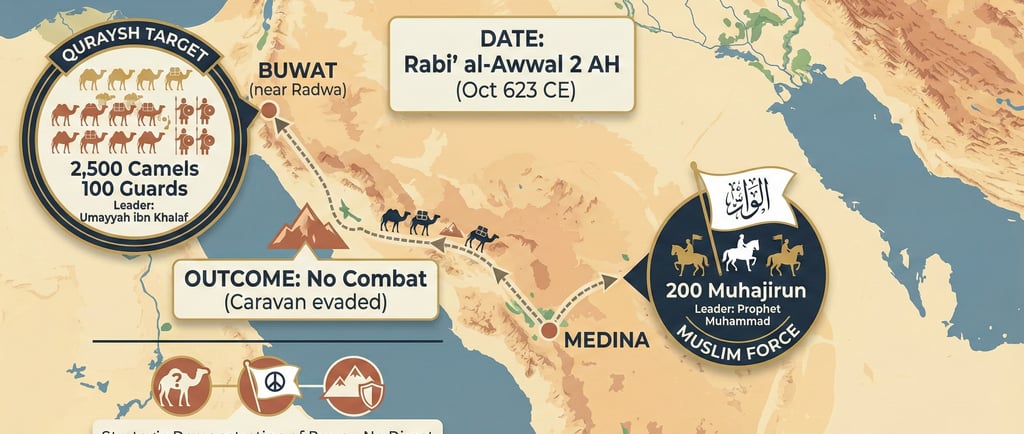
Date: The expedition was launched in the month of Rabi' al-Awwal in the second year of the Hijrah (approximately October 623 CE).
Timeline: Historical sources indicate this event took place roughly thirteen months after the Prophet’s migration (Hijrah) to Medina.
Strategic Objectives
The primary objective of the patrol was economic interdiction. The Quraysh of Mecca relied heavily on trade caravans traveling north to Syria. By intercepting these caravans, the Muslims aimed to:
Exert economic pressure on the Quraysh, who had confiscated the property of Muslims in Mecca.
Challenge the Quraysh's safe passage through territories close to Medina.
Secure political alliances or neutrality from tribes inhabiting the trade routes.
Composition of the Muslim Force
Leadership: The expedition was led personally by Prophet Muhammad (peace be upon him).
Troop Strength: The force consisted of 200 riders (some sources suggest slightly fewer, but 200 is the commonly cited figure by Al-Waqidi and Ibn Hisham).
Demographics: The detachment was composed exclusively of the Muhajirun (Emigrants from Mecca). The Ansar (Helpers of Medina) did not participate in this specific patrol.
The Banner: The standard of the Muslim army was white and was entrusted to Sa'd ibn Abi Waqqas.
Administration of Medina
In keeping with his established protocol during absences, the Prophet (peace be upon him) appointed a deputy to manage the affairs of Medina. Historical accounts offer two variations regarding this appointment:
Ibn Hisham reports that the responsibility was given to Al-Sa'ib ibn Uthman ibn Maz'un.
Al-Waqidi states that the deputy was Sa'd ibn Mu'adh, the chieftain of the Aws tribe.
The Opposing Force
The target was a massive Quraysh trade caravan returning from the Levant.
Caravan Leader: The caravan was commanded by Umayyah ibn Khalaf, a prominent leader of the Quraysh and a staunch opponent of Islam.
Assets: It was a high-value target, reportedly consisting of 2,500 camels laden with goods.
Protection: The caravan was guarded by a force of 100 men from the Quraysh.
Geography and Maneuvers
Destination: The Muslim force advanced to Buwat, a location defined by a mountain range belonging to the Juhaynah tribe.
Location Context: Buwat is situated near Radwa, flanking the coastal route often utilized by Meccan caravans.
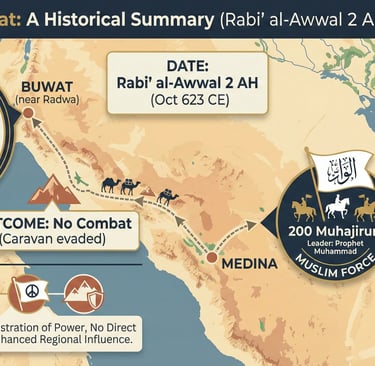
Outcome: Despite the mobilization, no direct confrontation occurred. The Quraysh caravan, likely alerted to the movement or by sheer chance, utilized an alternative, less-traveled route or moved with speed that allowed them to evade the Muslim force. The Prophet (peace be upon him) and his companions returned to Medina without engaging in battle.
Historical Significance
Although the Patrol of Buwat did not result in a military victory or the capture of spoils, it was instrumental in:
Projecting Power: It signaled to the Quraysh and neighboring tribes that the Muslims were an active military and political entity capable of threatening Mecca's economic lifelines.
Training: These early patrols provided essential field experience for the Muhajirun in reconnaissance, mobilization, and desert maneuvers.
Regional Diplomacy: The movement of troops through tribal lands (like those of Juhaynah) helped establish the Muslims' presence and paved the way for future treaties.
Full References:
[1] Al-Waqidi, M. I. (1989). Kitab al-Maghazi (M. Jones, Ed.; 3rd ed., Vol. 1). Dar al-A'lami.
[71] Ibn Hisham, A. M. (1955). Al-Sirah al-Nabawiyyah (M. al-Saqqa, I. al-Abyari, & A. Shalabi, Eds.; 2nd ed., Vol. 2). Mustafa al-Babi al-Halabi.
[127] Ibn Sayyid al-Nas, M. (1993). Uyun al-Athar (I. M. Ramadan, Ed.; Vol. 1). Dar al-Qalam.