
The Patrol of Dhu Al-Ushairah: A Strategic and Diplomatic Mission
The Patrol of Dhu Al-Ushairah (Arabic: غزوة ذي العشيرة) represents one of the significant early military movements led personally by the Prophet Muhammad (peace be upon him) prior to the Great Battle of Badr. It was undertaken to intercept a Quraysh caravan and to consolidate strategic alliances with tribes residing along the trade routes.
SEERAHPOLITICSMILITARYHISTORYTHE MILITARY HISTORY OF THE SEERAH
Abdur Sami
12/29/20253 min read
Timing and Departure
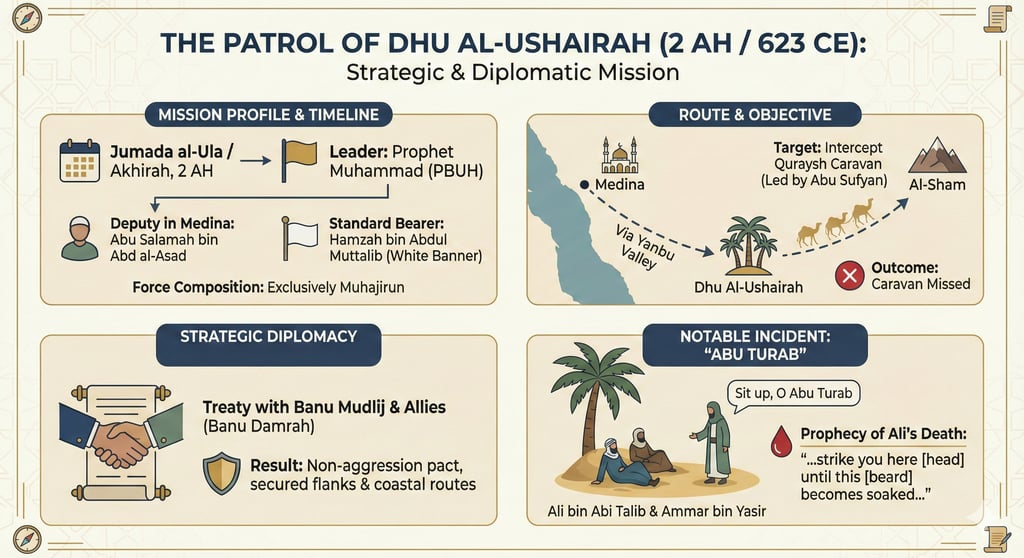
Historical sources indicate that this expedition took place during the month of Jumada al-Ula or the beginning of Jumada al-Akhirah in the second year of the Hijrah.
Al-Waqidi specifies that the Prophet set out regarding Dhu Al-Ushairah in the sixteenth month after his migration (Hijrah) to Medina (Al-Waqidi, Kitab al-Maghazi, Vol. 1).
Al-Maqrizi confirms that the Prophet resided in Medina for the remainder of Jumada al-Ula and a few nights of Jumada al-Akhirah before launching this campaign (Al-Maqrizi, Imta' al-Asma', Vol. 1).
Leadership and Logistics
The Prophet (peace be upon him) organized the administration of Medina and the military structure of the patrol as follows:
Succession in Medina: The Prophet appointed Abu Salamah bin Abd al-Asad as his deputy to govern Medina in his absence (Al-Waqidi, Kitab al-Maghazi, Vol. 1; Ibn Hisham, Al-Sirah al-Nabawiyyah, Vol. 1).
The Standard Bearer: The banner of the Muslims, which was white, was carried by Hamzah bin Abdul Muttalib (Al-Waqidi, Kitab al-Maghazi, Vol. 1; Ibn Hisham, Al-Sirah al-Nabawiyyah, Vol. 1).
Force Composition: The expedition consisted exclusively of the Muhajirun (Emigrants), with no Ansar (Helpers) participating (Ibn Hisham, Al-Sirah al-Nabawiyyah, Vol. 1).
Objective and Movements
The primary military objective was to intercept a trade caravan belonging to the Quraysh of Mecca, which was traveling towards Al-Sham (Greater Syria).
The Route: The Prophet (peace be upon him) took a route passing through the valley of Yanbu, eventually landing at Dhu Al-Ushairah in the valley of Yanbu (Ibn Hisham, Al-Sirah al-Nabawiyyah, Vol. 1).
The Target: The caravan was led by Abu Sufyan bin Harb. However, by the time the Muslim forces arrived, the caravan had already passed several days prior (Al-Waqidi, Kitab al-Maghazi, Vol. 1).
Historical Context: This specific caravan, which eluded the Muslims at Dhu Al-Ushairah, was the very same caravan the Prophet sought to intercept upon its return from Syria, an event that directly precipitated the Great Battle of Badr (Ibn Hisham, Al-Sirah al-Nabawiyyah, Vol. 1).
Strategic Outcome: The Treaty with Banu Mudlij
Although the military objective of seizing the caravan was not met, the expedition achieved a significant diplomatic victory. The Prophet (peace be upon him) established a non-aggression pact with the local tribes.
He concluded a treaty with Banu Mudlij and their allies from Banu Damrah. This agreement secured the neutrality or support of these tribes, securing the flanks of Medina and the coastal trade routes (Ibn Hisham, Al-Sirah al-Nabawiyyah, Vol. 1; Al-Maqrizi, Imta' al-Asma', Vol. 1).
The Incident of "Abu Turab"
A notable biographical event occurred during this expedition involving Ali bin Abi Talib and Ammar bin Yasir.
The Event: While the army was camped at Dhu Al-Ushairah, Ali bin Abi Talib and Ammar bin Yasir fell asleep on a mound of soft earth/sand near some palm trees. The Prophet (peace be upon him) found them covered in dust. He nudged Ali with his foot and said, "Sit up, O Abu Turab" (Father of Dust), a nickname that Ali cherished thereafter.
The Prophecy: On this occasion, the Prophet prophesied the manner of Ali's future death. He asked them, "Shall I tell you of the two most wretched people?" They replied, "Yes." He described the killer of the Camel of Thamud, and then said (referring to Ali): "And the one who will strike you here [pointing to Ali's head] until this [his beard] becomes soaked with it [blood]" (Al-Bayhaqi, Dala'il al-Nubuwwah, Vol. 3; Ibn Hisham, Al-Sirah al-Nabawiyyah, Vol. 1).
Duration
The Prophet (peace be upon him) and his companions remained away from Medina for a significant period during this patrol.
Al-Maqrizi notes that the Prophet spent the remainder of Jumada al-Ula and nights of Jumada al-Akhirah on this campaign (Al-Maqrizi, Imta' al-Asma', Vol. 1).
References:
Al-Bayhaqi, A. (n.d.). Dala'il al-Nubuwwah (Vol. 3).
Al-Maqrizi, A. (n.d.). Imta' al-Asma' (Vol. 1).
Al-Waqidi, M. (n.d.). Kitab al-Maghazi (Vol. 1).
Ibn Hisham, A. (n.d.). Al-Sirah al-Nabawiyyah (Vol. 1).