
The Raid of Al-Qarada (Sariyyah al-Qarada)
The Raid of Al-Qarada (سرية القردة) was a significant military expedition dispatched by the Prophet Muhammad (peace be upon him) in the early years of the Islamic state in Medina. It marked a strategic shift in the economic blockade against the Quraysh (قريش) and demonstrated the reach of the Muslim forces into the Najd region.
THE MILITARY HISTORY OF THE SEERAHSEERAHPOLITICSMILITARYHISTORY
Abdur Sami
1/4/20262 min read
Chronology and Leadership
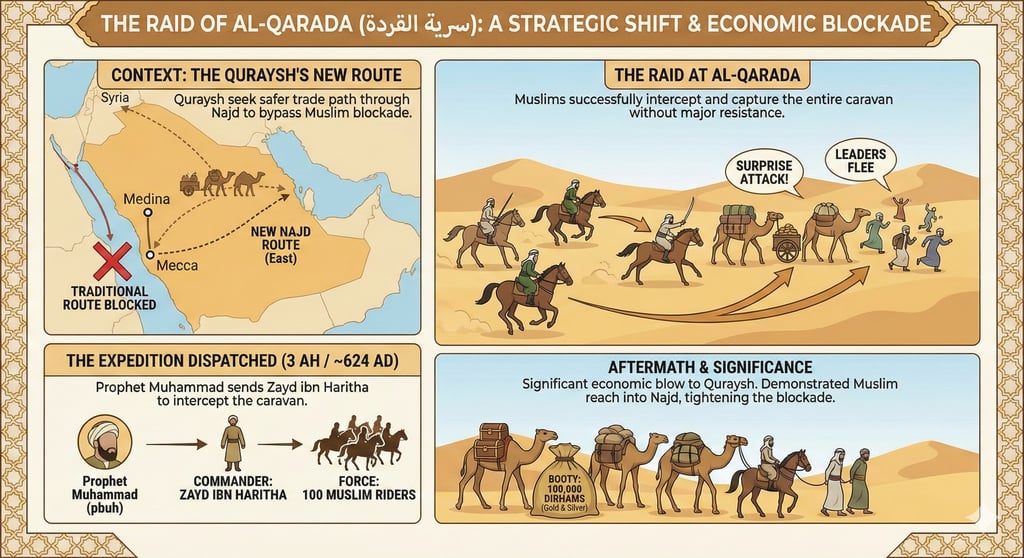
Historians place this expedition in the month of Jumada al-Akhira (جمادى الآخرة) in the third year of the Hijrah (approximately 28 months after the migration) (Al-Azami, 2011).
The Prophet (peace be upon him) appointed Zaid ibn Harithah (زيد بن حارثة) as the commander of this expedition. This appointment highlights Zaid’s growing role as a military leader entrusted with high-stakes missions (Al-Azami, 2011).
Background and Strategic Context
Following the Battle of Badr, the Quraysh faced a severe economic crisis. The Muslims blocked the traditional coastal trade route to Al-Sham (the Levant). Safwan ibn Umayyah (صفوان بن أمية), a leader of the Quraysh, expressed his frustration to his people, stating that Muhammad and his companions had ruined their trade and that the Quraysh did not know which path to take, as the Muslims patrolled the coast (Al-Azami, 2011).
The Quraysh feared that if they remained in Mecca without trading, they would consume their capital and perish, as their livelihood depended on the summer trade to Al-Sham and the winter trade to Abyssinia. Under this pressure, al-Aswad ibn al-Muttalib (الأسود بن المطلب) suggested avoiding the coastal route entirely and taking the inland route through Iraq (via Najd) to reach Al-Sham. He recommended a guide named Furat ibn Hayyan (فرات بن حيان) from the Banu Bakr ibn Wa'il tribe to lead them on this unfamiliar path (Al-Azami, 2011).
Intelligence Gathering
The Muslims became aware of this secret plan through a stroke of intelligence gathering in Medina. Nu'aym ibn Mas'ud (نعيم بن مسعود)—who was still a polytheist at the time—arrived in Medina and engaged in a drinking session (before the prohibition of alcohol) with a Jew named Salit ibn an-Nu'man (سليط بن النعمان) (or Kanana bin Abi al-Huqayq in some variations). Under the influence of wine, Nu'aym boasted about the caravan led by Safwan ibn Umayyah, revealing that it carried vast wealth and was taking the Iraq route. Salit immediately left the gathering and informed the Prophet (peace be upon him) of the details (Al-Azami, 2011).
The Expedition and the Interception
Acting swiftly on this intelligence, the Prophet (peace be upon him) mobilized Zaid ibn Harithah with a force of one hundred horsemen. Zaid marched into the Najd region and successfully intercepted the Quraysh caravan at a watering place called Al-Qarada (ماء القردة) (Al-Azami, 2011).
Outcome and Spoils
The raid was a complete success for the Muslims and a disaster for the Quraysh:
Flight of the Quraysh: Upon encountering the Muslim force, the guards and leaders of the caravan, including Safwan ibn Umayyah, fled the scene, abandoning their goods (Al-Azami, 2011).
The Spoils: The Muslims captured the entire caravan. The spoils included vessels (awani) and silver (fidda). The total value of the captured wealth was estimated at 100,000 dirhams (Al-Azami, 2011).
Captives: The Muslims captured the guide of the caravan, Furat ibn Hayyan. He was brought back to Medina, where he subsequently embraced Islam (Al-Azami, 2011).
Strategic Implications
This raid tightened the economic blockade on Mecca. It proved to the Quraysh that even the alternative inland desert routes were no longer safe from the reach of the Muslim forces, thereby escalating the conflict that would eventually lead to the Battle of Uhud.
References
Al-Waqidi, Muhammad ibn Umar. (1984). Kitab al-Maghazi (Vol. 1). (M. Jones, Ed.). Beirut: Alam al-Kutub.
Al-Salihi Al-Shami, Muhammad ibn Yusuf. (1993). Subul al-Huda wa al-Rashad fi Sirat Khayr al-Abad (Vol. 1). (A. A. Abdel-Mawjud & A. M. Moawad, Eds.). Beirut: Dar al-Kutub al-Ilmiyyah.
Al-Azami, Musa ibn Rashid. (2011). Al-Lolo Al-Maknoun fi Sirat al-Nabi al-Ma'mun (Vol. 2). Kuwait: Al-Maktaba Al-Amiriyyah.