
The Siege of Banu Qaynuqa: A Historical Analysis from Classical Manuscripts
The Siege of Banu Qaynuqa marks the first major military confrontation between the Muslims and the Jewish tribes of Medina following the Battle of Badr. This research article reconstructs the events leading to the siege, the political dynamics involving Abdullah bin Ubayy bin Salul, and the subsequent expulsion of the tribe to Adhri'at. The narrative is derived exclusively from primary Islamic historical sources, specifically Kitab al-Maghazi by Al-Waqidi and Al-Sirah al-Nabawiyyah by Ibn Hisham.
THE MILITARY HISTORY OF THE SEERAHSEERAHPOLITICSMILITARYHISTORY
Abdur Sami
12/29/20253 min read
1. Historical Context and Chronology
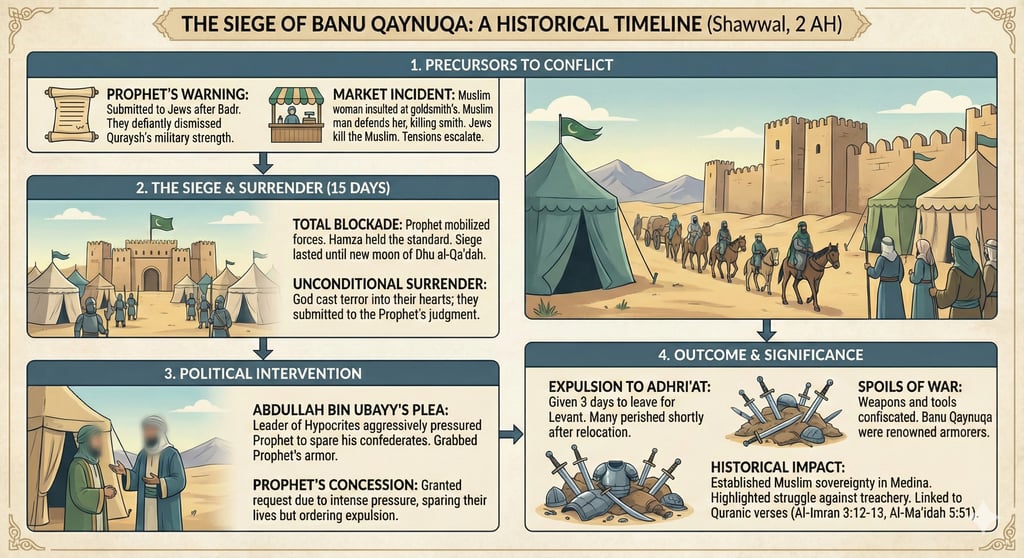
The campaign against Banu Qaynuqa occurred in the month of Shawwal, in the second year of the Hijra (approximately 20 months after the Prophet's migration to Medina). Historians place this event shortly after the Muslims' victory at the Battle of Badr, specifically on a Saturday in the middle of Shawwal.
2. Precursors to the Conflict
2.1 The Prophet’s Warning
Following the victory at Badr, the Prophet Muhammad gathered the Jews of Banu Qaynuqa in their market. He warned them to submit to Islam before they faced a fate similar to that of the Quraysh at Badr. The response from Banu Qaynuqa was defiant; they dismissed the military capability of the Quraysh, stating:
"O Muhammad, do not be deceived by the fact that you killed a group of people from Quraysh who were inexperienced and did not know how to fight. By Allah, if we fight you, you will know that we are the real men".
2.2 The Incident in the Market
The immediate catalyst for hostilities was an incident involving a Muslim woman. She brought merchandise to sell in the market of Banu Qaynuqa and sat near a goldsmith's shop. The men present demanded she unveil her face, which she refused. The goldsmith then surreptitiously tied the hem of her garment to her back. When she stood up, her garment was raised, exposing her, which caused the Jewish men to laugh. The woman cried out for help, prompting a Muslim man to attack and kill the goldsmith. In retaliation, the Jews killed the Muslim man. This event escalated into a call for arms among the Muslims.
3. The Siege and Surrender
The Prophet mobilized the Muslim forces and besieged the fortress of Banu Qaynuqa. The siege lasted for 15 days and nights, continuing until the new moon of Dhu al-Qa'dah. The blockade was total, preventing any entry or exit. Eventually, God cast terror into their hearts, and they surrendered unconditionally to the judgment of the Prophet.
During the siege, the standard of the Prophet was carried by Hamza bin Abdul Muttalib. The Prophet appointed Abu Lubabah Bashir bin Abdul Mundhir to oversee Medina in his absence.
4. The Political Intervention of Abdullah bin Ubayy
Abdullah bin Ubayy bin Salul, the leader of the Khazraj and the head of the Hypocrites (Munafiqun), intervened aggressively on behalf of Banu Qaynuqa, as they were his confederates (mawali).
When the Prophet prepared to pass judgment (which implies execution for their treachery), Abdullah bin Ubayy approached him and said, "O Muhammad, treat my mawali well." The Prophet turned away from him. Ibn Ubayy then grabbed the Prophet by the opening of his armor (dir'). The Prophet’s face darkened with anger, and he commanded, "Let me go!" Ibn Ubayy persisted, saying:
"By Allah, I will not let you go until you treat my mawali well. Four hundred men without armor and three hundred with armor protected me from the Red and the Black [enemies], and you would harvest them in one morning? By Allah, I fear the turn of fortune".
Due to this intense pressure, the Prophet granted his request, saying, "They are yours," thereby sparing their lives but ordering their expulsion.
5. Expulsion and Spoils
The Prophet ordered that Banu Qaynuqa be expelled from Medina. He assigned Ubada bin al-Samit to oversee their departure. They were given a deadline of three days to leave. They eventually departed towards the Levant (Sham) and settled in Adhri'at, a region near the borders of Arabia and Syria. Historical records note that they did not survive long after their relocation, with many perishing shortly thereafter.
The Muslims confiscated their weapons and tools as spoils of war. The inventory of seized arms included armor and weaponry, as Banu Qaynuqa were renowned goldsmiths and armorers.
6. Quranic Revelations
Sources link specific Quranic verses to these events:
Surah Al-Imran (3:12-13): "Say to those who disbelieve, 'You will be overcome and gathered together to Hell...'" This was revealed following their defiant response to the Prophet's warning.
Surah Al-Ma'idah (5:51): "O you who have believed, do not take the Jews and the Christians as allies..." This verse is reported to have been revealed regarding the contrasting attitudes of Abdullah bin Ubayy, who clung to his alliance with the Jews, and Ubada bin al-Samit, who renounced his alliance with them in favor of Allah and His Messenger.
7. Conclusion
The Siege of Banu Qaynuqa established the sovereignty of the Muslim state in Medina and demonstrated the Prophet’s resolve against internal treachery. It also highlighted the internal political struggle between the faithful believers and the hypocrites, setting a precedent for dealing with treaty violations.
References
Al-Waqidi, M. (n.d.). Kitab al-Maghazi. [Uploaded Manuscript].
Ibn Hisham, A. (n.d.). Al-Sirah al-Nabawiyyah. [Uploaded Manuscript].